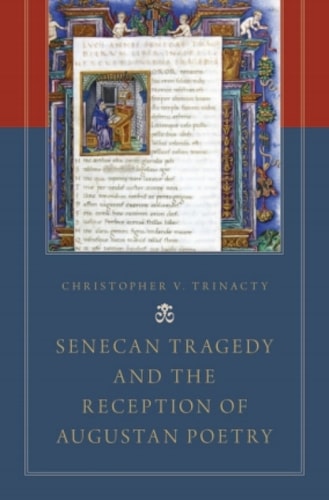
Senecan Tragedy and the Reception of Augustan Poetry
0
0
As an Amazon Associate and affiliate partner, Menrva Books earns from qualifying purchases. Learn more
Author Description
In their practice of aemulatio, the mimicry of older models of writing, the Augustan poets often looked to the Greeks: Horace drew inspiration from the lyric poets, Virgil from Homer, and Ovid from Hesiod, Callimachus, and others. But by the time of the great Roman tragedian Seneca, the Augustan poets had supplanted the Greeks as the "classics" to which Seneca and his contemporaries referred. Indeed, Augustan poetry is a reservoir of language, motif, and thought for Seneca's writing. Strangely, however, there has not yet been a comprehensive study revealing the relationship between Seneca and his Augustan predecessors. Christopher Trinacty's Senecan Tragedy and the Reception of Augustan Poetry is the long-awaited answer to the call for such a study. Senecan Tragedy and the Reception of Augustan Poetry uniquely places Senecan tragedy in its Roman literary context, offering a further dimension to the motivations and meaning behind Seneca's writings. By reading Senecan tragedy through an intertextual lens, Trinacty reveals Seneca's awareness of his historical moment, in which the Augustan period was eroding steadily around him. Seneca, looking back to the poetry of Horace, Virgil, and Ovid, acts as a critical interpreter of both their work and their era. He deconstructs the language of the Augustan poets, refiguring it through the perspective of his tragic protagonists. In doing so, he positions himself as a critic of the Augustan tradition and reveals a poetic voice that often subverts the classical ethos of that tradition. Through this process of reappropriation Seneca reveals much about himself as a playwright and as a man: In the inventive manner in which he re-employs the Augustan poets' language, thought, and poetics within the tragic framework, Seneca gives his model works new--and uniquely Senecan--life. Trinacty's analysis sheds new light both on Seneca and on his Augustan predecessors.
Menrva's Summary
THE THESIS
This book investigates the intertextual relationship between the tragedies of Seneca and the works of Augustan poets, arguing that Seneca utilized these predecessors as a critical reservoir to define his own literary voice. Christopher V. Trinacty, a scholar of classical literature, employs a rigorous philological and intertextual framework to examine how Seneca reappropriated the language and motifs of Horace, Virgil, and Ovid. By analyzing these connections, the author demonstrates that Seneca was not merely imitating his predecessors but actively deconstructing and subverting the Augustan ethos to reflect his own historical context. The study provides a comprehensive analysis of how this process of reappropriation informs the meaning and motivation behind Senecan drama.
THE SCOPE MAP
What You Will Find
- Detailed intertextual analysis of Seneca's tragedies alongside the works of Horace, Virgil, and Ovid.
- A methodology focused on the Roman practice of aemulatio and its evolution into the post-Augustan period.
- Examination of how Seneca refigures Augustan poetic language through the voices of his tragic protagonists.
- Evidence drawn from close readings of primary Latin texts and historical literary context.
THE AUTHORITY PERSPECTIVE
Scholars and students of classical antiquity view this work as a significant contribution to the study of Roman literary reception and the evolution of the tragic genre. Readers frequently note the academic density of the prose, which serves as a foundational text for those interested in the complex interplay between Silver Age drama and the Augustan poetic tradition.
Page Count:
272
Publication Date:
2014-01-01
Publisher:
Oxford University Press
ISBN-10:
0199356572
ISBN-13:
9780199356577
Poetry
History
Drama
Intertextuality
English
Ancient History
English & College Success
Latin poetry
Literary Criticism
Community Tags
Other Editions(2)

Similar Books


Reader Comments
Share Your Thoughts
No comments yet. Be the first to share your thoughts!