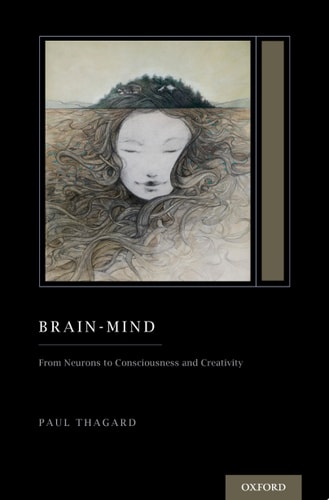
Brain-Mind: From Neurons to Consciousness and Creativity
0
0
As an Amazon Associate and affiliate partner, Menrva Books earns from qualifying purchases. Learn more
Author Description
How do brains make minds? Paul Thagard presents a unified, brain-based theory of cognition and emotion with applications to the most complex kinds of thinking, right up to consciousness and creativity. Neural mechanisms are used to explain mental operations for analogy, action, intention, language, and the self.Brain-Mind develops a brilliant account of mental operations using promising new ideas from theoretical neuroscience. Single neurons cannot do much by themselves, but groups of neurons work together to accomplish powerful kinds of mental representation, including concepts, images, and rules. Minds enable people to perceive, imagine, solve problems, understand, learn, speak, reason, create, and be emotional and conscious. Competing explanations of how the mind works have identified it as soul, computer, brain, dynamical system, or social construction. This book explains minds in terms of interacting mechanisms operating at multiple levels, including the social, mental, neural, and molecular. Unification comes from systematic application of Chris Eliasmith's powerful Semantic Pointer Architecture, a highly original synthesis of neural network and symbolic ideas about how the mind works. This book belongs to a trio that includes Mind-Society: From Brains to Social Sciences and Professions and Natural Philosophy: From Social Brains to Knowledge, Reality, Morality, and Beauty. They can be read independently, but together they make up a Treatise on Mind and Society that provides a unified and comprehensive treatment of the cognitive sciences, social sciences, professions, and humanities.
Menrva's Summary
THE THESIS
This book investigates the fundamental question of how biological brain mechanisms generate the complex phenomena of human consciousness and creativity. Paul Thagard, a prominent cognitive scientist and philosopher, utilizes the Semantic Pointer Architecture to bridge the gap between neural activity and high-level mental operations. The text argues for a multi-level approach that integrates neural, mental, and social mechanisms to provide a comprehensive explanation of human cognition.
THE SCOPE MAP
What You Will Find
- A theoretical framework based on the Semantic Pointer Architecture
- Explanations of mental processes including analogy, intention, and language
- Analysis of how groups of neurons form concepts, images, and rules
- Integration of cognitive science with theoretical neuroscience
Scope Limits
- Does not provide a purely computational or purely sociological account of mind
- Does not focus on clinical pathology or neurological disorders
THE AUTHORITY PERSPECTIVE
Experts recognize this work as a significant contribution to the unification of cognitive science and neuroscience. Readers frequently note the technical density of the prose, which requires a foundational understanding of cognitive modeling to fully grasp the proposed mechanisms.
Page Count:
336
Publication Date:
2019-01-01
Publisher:
Oxford University Press
ISBN-10:
0190686383
ISBN-13:
9780190686383
Psychology
Philosophy
Neuroscience
Physiology
Philosophy of
Mind & Body
Community Tags
Similar Books