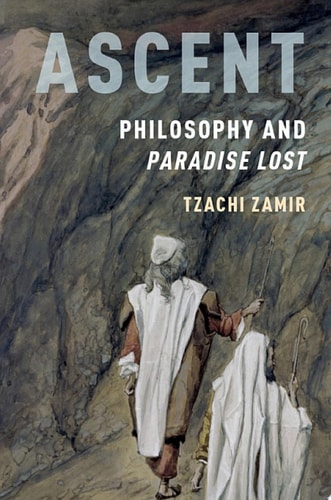
Ascent: Philosophy and Paradise Lost
0
0
As an Amazon Associate and affiliate partner, Menrva Books earns from qualifying purchases. Learn more
Author Description
Paradise Lost has never received a substantial, book-length reading by a philosopher. This, however should surprise no one, for Milton himself despised philosophers. He associated philosophy with deceit in his theological writings, and made philosophizing into one of the activities of fallen angels in hell. Yet, in this book, philosopher and literary critic Tzachi Zamir argues that Milton's disdain for their vocation should not prevent philosophers from turning an inquisitive eye to Paradise Lost. Because Milton's greatest poem conducts a multilayered examination of puzzles that intrigue philosophers, instead of neatly breaking from philosophy, it maintains a penetrating rapport with it. Paradise Lost sets forth bold claims regarding the meaning of genuine knowledge, or acting meaningfully, or taking in the world fully, or successfully withdrawing from inner deadness. Other topics touched upon by Milton involve some of the most central issues within the philosophy of religion: the relationship between reason and belief, the uniqueness of religious poetry, the meaning of gratitude, and the special role of the imagination in faith. This tension-disparaging philosophy on the one hand, but taking up much of what philosophers hope to understand on the other-turns Milton's poem into an exceptionally potent work for a philosopher of literature. Ascent is a philosophical reading of the poem that attempts to keep audible Milton's anti-philosophy stance. The picture of interdisciplinarity that emerges is, accordingly, neither one of a happy percolation among fields ('philosophy', 'literature'), nor one of rigid boundaries. Overlap and partial agreement clash against contestation and rivalry. It is these conflicting currents which Ascent aims to capture, if not to reconcile.
Menrva's Summary
THE THESIS
This book investigates the complex, often adversarial relationship between John Milton's epic poem Paradise Lost and the discipline of philosophy. Tzachi Zamir, a philosopher and literary critic, argues that while Milton explicitly disparaged philosophy, his work engages deeply with fundamental philosophical inquiries. Zamir utilizes a framework that respects Milton's anti-philosophical stance while simultaneously demonstrating how the poem functions as a site for rigorous intellectual exploration of knowledge, faith, and human agency.
THE SCOPE MAP
What You Will Find
- Analysis of Milton's theological and poetic treatment of reason, belief, and imagination.
- Examination of the intersection between literary narrative and philosophical inquiry.
- Exploration of themes including gratitude, the nature of genuine knowledge, and the concept of inner deadness.
Scope Limits
- The text does not provide a comprehensive biography of John Milton.
- It does not attempt to resolve the conflict between literature and philosophy, but rather to map the tension between them.
THE AUTHORITY PERSPECTIVE
Experts recognize this work as a unique contribution to Milton studies, specifically for its attempt to bridge the gap between literary analysis and philosophical inquiry. Readers frequently note the academic density of the prose, which is tailored for those familiar with both Miltonic scholarship and philosophical discourse.
Page Count:
214
Publication Date:
2017-01-01
Publisher:
Oxford University Press
ISBN-10:
0190695102
ISBN-13:
9780190695101
Poetry
Religion
Philosophy
English & College Success
English
Literary Criticism
Academic
Community Tags
Similar Books