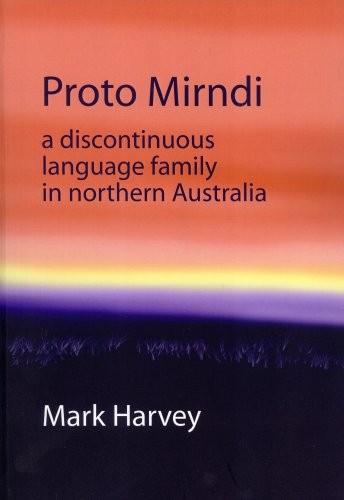
Proto Mirndi: A Discontinuous Language Family in Northern Australia
0
0
As an Amazon Associate and affiliate partner, Menrva Books earns from qualifying purchases. Learn more
Author Description
The Mirndi language family is one of the very few discontinuous language families that have been proposed for Australia. This reconstruction shows that there is a sufficient evidentiary basis, according to the canons of standard historical linguistics, to show that the Mirndi languages constitute a distinct language family. The evidence comes from closed class morphemes, both grammatical and lexical. The evidence from open, lexical classes is negligible and would not suffice to establish the family. The reconstruction also considers the evidence as to the territorial associations of Proto-Mirndi. There are a number of strands of evidence, which though limited, all converge in indicating that the territorial associations of Proto-Mirndi were in the vicinity of the south-western Gulf of Carpentaria. As such, this implies shifts in territorial affiliations of the Mirndi varieties from east to west. In addition its linguistic aspects, the reconstruction also provides a detailed overview of the history of subsections. Subsections are a salient social construct across much of north-central and north-western Australia. The reconstruction shows that subsections are of considerable time depth, and also that the diffusion of subsections is of considerable time depth.--Provided by publisher.
Menrva's Summary
THE THESIS
This book reconstructs the Proto-Mirndi language family, arguing for its distinctness within Australia based on linguistic evidence. The author, Mark Harvey, presents a historical linguistic analysis, focusing on closed class morphemes (grammatical and lexical) as the primary evidence for the family's existence, while noting the limited support from open lexical classes. The study also investigates the territorial associations of Proto-Mirndi, converging evidence suggests a location near the south-western Gulf of Carpentaria, implying a westward shift in territorial affiliations. Furthermore, the book delves into the history of subsections, a significant social construct in north-central and north-western Australia, establishing their considerable time depth and diffusion.
THE SCOPE MAP
- Reconstruction of the Proto-Mirndi language family.
- Argument for the distinctness of the Mirndi language family in Australia.
- Analysis of closed class morphemes (grammatical and lexical) as primary evidence.
- Assessment of evidence from open, lexical classes.
- Investigation into the territorial associations of Proto-Mirndi.
- Convergence of evidence pointing to the south-western Gulf of Carpentaria.
- Implication of eastward to westward shifts in territorial affiliations.
- Detailed overview of the history of subsections as a social construct.
THE AUTHORITY PERSPECTIVE
This work is a scholarly examination of the Proto-Mirndi language family, presenting a rigorous linguistic argument for its classification. The author's reliance on specific linguistic evidence, particularly closed class morphemes, forms the core of the thesis. The book also integrates anthropological insights by discussing the historical context of subsections, suggesting a deep time depth for both the language family and this social structure. The scope of the research indicates a text aimed at specialists in historical linguistics and Australian Indigenous studies.
Page Count:
172
Publication Date:
2008-01-01
ISBN-10:
0858835886
ISBN-13:
9780858835887
Literary Fiction
Non-Fiction
Linguistics
Historical linguistics
Community Tags
Similar Books