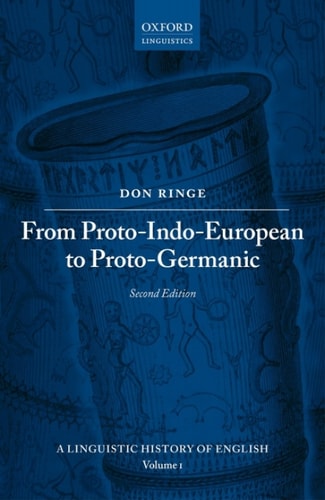
From Proto-Indo-European to Proto-Germanic
0
0
As an Amazon Associate and affiliate partner, Menrva Books earns from qualifying purchases. Learn more
Author Description
This book describes the earliest reconstructable stages of the prehistory of English, focusing specifically on linguistic structure. It outlines the grammar of Proto-Indo-European, considers the changes by which one dialect of that prehistoric language developed into Proto-Germanic, and provides a detailed account of the grammar of Proto-Germanic. In the course of his exposition Don Ringe draws on a long tradition of work on many languages, including Hittite, Sanskrit, Greek, Latin, Slavic, Gothic, and Old Norse. This second edition has been significantly revised to provide a more in-depth account of Proto-Indo-European, with further exploration of disputed points; it has also been updated to include new developments in the field, particularly in the reconstruction of the Proto-Indo-European verb and nominal inflection. The author also reconsiders some of his original approaches to specific linguistic changes and their relative chronology based on his recent research. This new edition of the first volume in A Linguistic History of English will be of central interest to all scholars and students of comparative Indo-European and Germanic linguistics, the history of English, and historical linguistics more generally. The second volume, The Development of Old English by Don Ringe and Ann Taylor, was published by OUP in 2014 (paperback 2016)
Menrva's Summary
THE THESIS
This text investigates the linguistic evolution from Proto-Indo-European to Proto-Germanic, establishing the structural foundations of the English language. Don Ringe, a specialist in historical linguistics, utilizes comparative data from ancient languages such as Hittite, Sanskrit, and Gothic to reconstruct these prehistoric stages. The work provides a rigorous grammatical framework for understanding the phonological and morphological shifts that defined the transition between these language families.
THE SCOPE MAP
What You Will Find
- Detailed grammatical reconstruction of Proto-Indo-European and Proto-Germanic
- Analysis of nominal and verbal inflectional systems
- Comparative evidence from Hittite, Greek, Latin, Slavic, and Old Norse
- Chronological mapping of specific linguistic sound changes
Scope Limits
- The text does not cover the subsequent development of Old English, which is addressed in the second volume of the series
- It focuses primarily on structural and comparative linguistics rather than sociolinguistic or cultural history
THE AUTHORITY PERSPECTIVE
Scholars and students of historical linguistics frequently cite this work as a foundational reference for the study of Germanic origins. The text is noted for its high level of academic density and its precise, technical approach to linguistic reconstruction.
Page Count:
416
Publication Date:
2017-01-01
Publisher:
OUP Oxford
ISBN-10:
0192511181
ISBN-13:
9780192511188
Historical linguistics
English
Germanic Philology
English & College Success
Linguistics
Language History
Community Tags
Similar Books