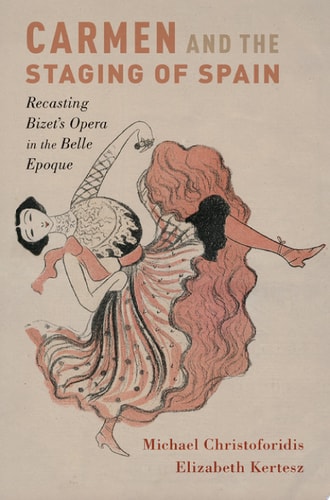
Carmen and the Staging of Spain: Recasting Bizet's Opera in the Belle Epoque
0
0
As an Amazon Associate and affiliate partner, Menrva Books earns from qualifying purchases. Learn more
Author Description
Carmen and the Staging of Spain explores the Belle Époque fascination with Spanish entertainment that refashioned Bizet's opera and gave rise to an international "Carmen industry." Authors Michael Christoforidis and Elizabeth Kertesz challenge the notion of Carmen as an unchanging exotic construct, tracing the ways in which performers and productions responded to evolving fashions for Spanish style from its 1875 premiere to 1915. Focusing on selected realizations of the opera in Paris, London and New York, Christoforidis and Kertesz explore the cycles of influence between the opera and its parodies; adaptations in spoken drama, ballet and film; and the panorama of flamenco, Spanish dance, and musical entertainments. Their findings also uncover Carmen's dynamic interaction with issues of Hispanic identity against the backdrop of Spain's changing international fortunes. The Spanish response to this now most-Spanish of operas is illuminated by its early reception in Madrid and Barcelona, adaptations to local theatrical genres, and impact on Spanish composers of the time. A series of Spanish Carmens, from opera singers Elena Sanz and Maria Gay to the infamous music-hall star La Belle Otero, had a crucial influence on the interpretation of the title role. Their stories provide a fresh context for the book's reappraisal of leading Carmens of the era, including Emma Calvé and Geraldine Farrar.
Menrva's Summary
THE THESIS
This work investigates how the Belle Époque era transformed Bizet's opera into a global cultural phenomenon by examining the shifting perceptions of Spanish identity and performance styles. Authors Michael Christoforidis and Elizabeth Kertesz utilize archival research and performance history to argue that the character of Carmen was not a static exotic construct but a dynamic figure shaped by international trends, parodies, and the specific contributions of diverse performers between 1875 and 1915.
THE SCOPE MAP
What You Will Find
- Analysis of the 'Carmen industry' across Paris, London, and New York.
- Examination of the interplay between the opera and contemporary Spanish dance, flamenco, and musical theater.
- Case studies of influential performers including Elena Sanz, Maria Gay, La Belle Otero, Emma Calvé, and Geraldine Farrar.
- Investigation into the reception of the opera within Spain, specifically Madrid and Barcelona.
Scope Limits
- The study focuses primarily on the period between the 1875 premiere and 1915.
- The analysis does not cover later 20th-century cinematic or avant-garde reinterpretations of the opera.
THE AUTHORITY PERSPECTIVE
Scholars and musicologists recognize this text as a rigorous examination of the intersection between operatic performance and national identity. Readers frequently note the academic density of the prose, which provides a comprehensive framework for understanding the evolution of one of the world's most performed operas.
Page Count:
338
Publication Date:
2018-01-01
Publisher:
Oxford University Press
ISBN-10:
0190694831
ISBN-13:
9780190694838
Music
European History
Music History
Musicology
Cultural History
Music Spanish
Opera
Humanities
Community Tags
Similar Books