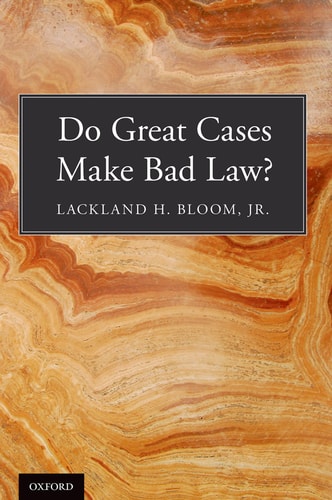
Do Great Cases Make Bad Law?
0
0
As an Amazon Associate and affiliate partner, Menrva Books earns from qualifying purchases. Learn more
Author Description
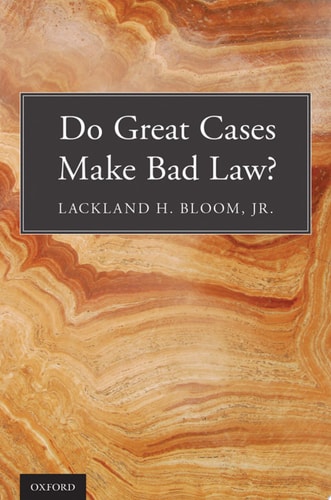
"Great cases like hard cases make bad law" declared Justice Oliver Wendell Holmes, Jr. in his dissenting opinion in the Northern Securities antitrust case of 1904. His maxim argues that those cases which ascend to the Supreme Court of the United States by virtue of their national importance, interest, or other extreme circumstance, make for poor bases upon which to construct a general law. Frequently, such cases catch the public's attention because they raise important legal issues, and they become landmark decisions from a doctrinal standpoint. Yet from a practical perspective, great cases could create laws poorly suited for far less publicly tantalizing but far more common situations.Lackland H. Bloom, Jr. tests Justice Holmes' dictum in Do Great Cases Make Bad Law? He analyzes in detail the history of the Supreme Court's great cases, from Marbury v. Madison in 1803, to National Federation of Independent Business v. Sebelius, the Patient Protection and Affordable Care Act case in 2012. He treats each case with its own chapter, and explains why the Court found a case compelling, how the background and historical context affected the decision and its place in constitutional law and history, how academic scholarship has treated the case, and how the case integrates with and reflects off of Justice Holmes' famous statement. In doing so, Professor Bloom draws on the whole of the Supreme Court's decisional history to form an intricate scholarly understanding of the holistic significance of the Court's reasoning in American constitutional law.
Menrva's Summary
THE THESIS
This book investigates the validity of Justice Oliver Wendell Holmes, Jr.'s assertion that high-profile Supreme Court cases, driven by national interest or extreme circumstances, result in poor legal precedents. Lackland H. Bloom, Jr., a legal scholar, examines this dictum by evaluating a series of landmark Supreme Court decisions spanning from 1803 to 2012. He utilizes historical context, doctrinal analysis, and academic scholarship to determine whether these significant cases create laws that are ill-suited for the more mundane, everyday legal matters they are intended to govern.
THE SCOPE MAP
What You Will Find
- A chronological analysis of landmark Supreme Court cases including Marbury v. Madison and the Affordable Care Act decision.
- A chapter-by-chapter breakdown of the historical and social background of each selected case.
- Integration of academic scholarship and constitutional theory regarding judicial decision-making.
Scope Limits
- The analysis is restricted to cases that reached the Supreme Court and achieved landmark status.
- The book does not provide a comprehensive history of all American law, focusing instead on the specific subset of 'great cases.'
THE AUTHORITY PERSPECTIVE
Legal scholars and students of constitutional law frequently cite this work for its rigorous examination of judicial reasoning and the impact of high-stakes litigation on legal doctrine. The text is noted for its academic density and its systematic approach to testing a foundational maxim of American jurisprudence.
Page Count:
454
Publication Date:
2017-09-15
Publisher:
Oxford University Press
ISBN-10:
0190840080
ISBN-13:
9780190840082
Constitutional Law
Law
Supreme Court
Legal History
United States