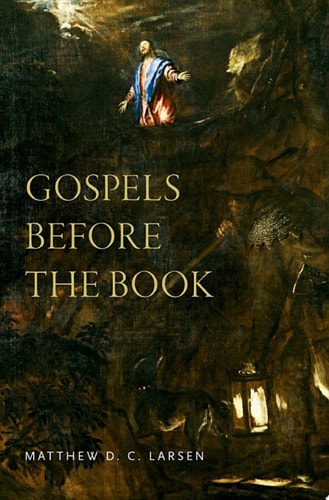
Gospels before the Book
0
0
As an Amazon Associate and affiliate partner, Menrva Books earns from qualifying purchases. Learn more
Author Description
What does it look like to read the texts we now call the gospels like first- and second-century readers? There is no evidence of anyone regarding the gospel as a book published by an author until the end of the second century. So, put differently, what does it mean to read the gospels "before the book"? For centuries, the ways people discuss the gospels have been shaped by later ideas that have more to do with the printing press and modern notions of the author than ancient writing and reading practices. In Gospels before the Book, Matthew D. C. Larsen challenges several subtle yet problematic assumptions about authors, books, and publication at work in early Christian studies. He then explores a host of under-appreciated elements of ancient textual culture such as unfinished texts, accidental publication, post-publication revision, and the existence of multiple authorized versions of the same work. Turning to the gospels, he argues that the earliest readers and users of the text we now call the Gospel according to Mark treated it not as a book published by an author, but as an unfinished, open, and fluid collection of notes (hypomnmata). In such a scenario, the Gospel according to Matthew would not be regarded as a separate book published by a different author, but as a continuation of the same unfinished gospel tradition. Similarly it is not the case that, of the five different endings in the textual tradition we now call the Gospel according to Mark, one is "right" and the others are "wrong." Rather each represents its own effort to fill a perceived deficiency in the gospel. Larsen offers a new methodological framework for future scholarship on early Christian gospels.
Menrva's Summary
THE THESIS
How did early Christian communities interact with gospel texts before the modern concept of a published book existed? Matthew D. C. Larsen, a scholar of early Christianity, challenges contemporary assumptions regarding authorship and publication by examining ancient reading practices. He argues that the gospels were originally treated as fluid, unfinished collections of notes rather than static, authored volumes, necessitating a shift in how modern scholars interpret textual variations and multiple versions.
THE SCOPE MAP
What You Will Find
- Analysis of ancient textual culture including post-publication revision and accidental publication.
- A methodological framework for interpreting early Christian gospel traditions as open-ended documents.
- Case studies on the Gospel of Mark and the Gospel of Matthew to illustrate the concept of hypomnemata.
Scope Limits
- The book does not provide a comprehensive history of the entire New Testament canon.
- It does not focus on theological interpretation of the gospel messages themselves, but rather on the material and cultural history of the texts.
THE AUTHORITY PERSPECTIVE
Scholars and students of early Christian history frequently cite this work for its rigorous challenge to traditional bibliographical assumptions. Experts highlight the text as a significant contribution to the study of ancient media and the material history of early Christian literature.
Page Count:
245
Publication Date:
2018-01-01
Publisher:
Oxford University Press
ISBN-10:
019084860X
ISBN-13:
9780190848606
Religion
History
Ancient History
Bibles
Christianity
Community Tags
Similar Books