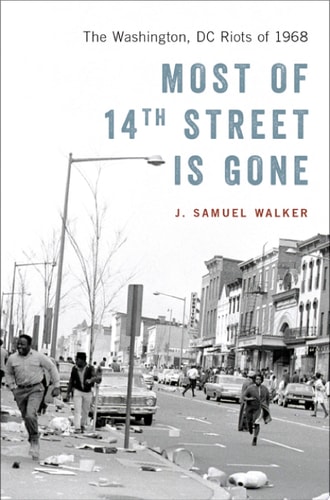
Most of 14th Street Is Gone: The Washington, DC Riots of 1968
0
0
As an Amazon Associate and affiliate partner, Menrva Books earns from qualifying purchases. Learn more
Author Description
"Left behind were hundreds of burned-out buildings, whole blocks that looked as though they had been bombed into oblivion." These words, written by the Washington Post's Leonard Downie Jr., do not describe a war zone but rather the nation's capital reeling in the wake of the riots of April 1968. In the devastating aftermath of Martin Luther King's assassination, a community already plagued by poor living conditions, unfair policing, and segregation broke into chaos.These riots brought well-documented tragedy and heartbreak--not only among the families of those who lost their lives but also among those who lost their homes, possessions, jobs, and businesses. There was anger, fear, and anxiety throughout the city of Washington, DC, from the White House to the residential neighborhoods of the capital. There was an excruciating dilemma for President Lyndon Johnson. He was outraged by the violence in the streets, but he also keenly aware that African American citizens who joined the riots had legitimate grievances that his civil rights initiatives did little to address.J. Samuel Walker's Most of 14th Street is Gone takes an in-depth look at the causes and consequences of the Washington, DC riots of 1968. It shows the conditions that existed in Washington, DC's low-income neighborhoods, setting the stage for the disorders that began after King's murder. It also traces the growing fears produced by the outbreaks of serious riots in many cities during the mid-1960s. The centerpiece of the book is a detailed account of the riots that raged in Washington, DC from the perspectives of rioters, victims, law enforcement officials, soldiers, and government leaders. The destruction was so extensive that parts of the city were described as "smoldering ruins block after block." Walker analyzes the reasons for the riots and the lessons that authorities drew from them. He also provides an overview of the struggle that the city of Washington, DC faced in recovering from the effects of the riots.
Menrva's Summary
THE THESIS
This book investigates the underlying causes and the immediate, devastating consequences of the 1968 Washington, DC riots following the assassination of Martin Luther King Jr. Author J. Samuel Walker, a historian, utilizes archival records, contemporary reporting, and government documentation to construct a comprehensive analysis of the civil unrest. He examines the intersection of systemic inequality, police relations, and the political pressures faced by the Lyndon B. Johnson administration during this period of national volatility.
THE SCOPE MAP
What You Will Find
- Detailed chronological account of the April 1968 riots in Washington, DC
- Analysis of the socio-economic conditions in low-income neighborhoods prior to the unrest
- Perspectives from diverse stakeholders including rioters, victims, law enforcement, and government officials
- Examination of the long-term recovery efforts and policy lessons learned by authorities
Scope Limits
- The narrative focuses primarily on the Washington, DC metropolitan area rather than a comparative study of all 1968 urban riots
- The text does not provide a comprehensive biography of Martin Luther King Jr. beyond the immediate impact of his assassination
THE AUTHORITY PERSPECTIVE
Experts and historians recognize this work as a definitive account of the specific events that reshaped the urban landscape of the nation's capital. Readers frequently note the meticulous research and the balanced presentation of perspectives from both government officials and affected community members.
Page Count:
195
Publication Date:
2018-01-01
Publisher:
Oxford University Press
ISBN-10:
0190844817
ISBN-13:
9780190844813
History
Poor Peoples Campaign
Social History
United States
Urban Studies
Civil Rights
American History
Washington DC
Community Tags
Similar Books