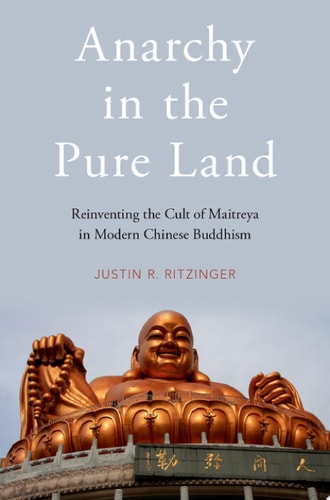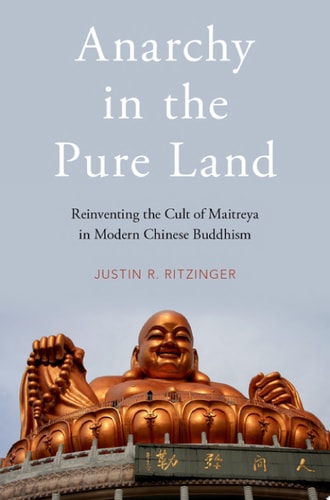
Anarchy in the Pure Land: Reinventing the Cult of Maitreya in Modern Chinese Buddhism
0
0
As an Amazon Associate and affiliate partner, Menrva Books earns from qualifying purchases. Learn more
Author Description
Anarchy in the Pure Land investigates the twentieth-century reinvention of the cult of Maitreya, the future Buddha, conceived by the reformer Taixu and promoted by the Chinese Buddhist reform movement. The cult presents an apparent anomaly: It shows precisely the kind of concern for ritual, supernatural beings, and the afterlife that the reformers supposedly rejected in the name of "modernity." This book shows that, rather than a concession to tradition, the reimagining of ideas and practices associated with Maitreya was an important site for formulating a Buddhist vision of modernity.Justin Ritzinger argues that the cult of Maitreya represents an attempt to articulate a new constellation of values, integrating novel understandings of the good, clustered around modern visions of utopia, with the central Buddhist goal of Buddhahood. In Part One he traces the roots of this constellation to Taixu's youthful career as an anarchist. Part Two examines its articulation in the Maitreya School's theology and its social development from its inception to World War II. Part Three looks at its subsequent decline and contemporary legacy within and beyond orthodox Buddhism. Through these investigations, Anarchy in the Pure Land develops a new framework for alternative understandings of modernity in Buddhism.
Menrva's Summary
THE THESIS
This book investigates how the twentieth-century Chinese Buddhist reform movement, led by the reformer Taixu, reinvented the cult of Maitreya to reconcile traditional supernatural beliefs with modern utopian ideals. Justin Ritzinger, a scholar of Chinese Buddhism, utilizes historical records and theological texts to argue that the Maitreya cult was not a regression to superstition, but a deliberate effort to construct a modern Buddhist vision. By tracing the intersection of anarchist political thought and religious practice, the author demonstrates how reformers integrated secular concepts of progress with the spiritual goal of Buddhahood.
THE SCOPE MAP
What You Will Find
- Historical analysis of Taixu's early career and his anarchist influences.
- Theological examination of the Maitreya School's development through World War II.
- Investigation into the decline and contemporary legacy of the Maitreya cult.
- A framework for understanding alternative modernities within religious traditions.
Scope Limits
- The study focuses primarily on the reformist movement led by Taixu rather than the entirety of Chinese Buddhist practice.
- The analysis does not provide a comprehensive history of Maitreya worship outside of the twentieth-century Chinese context.
THE AUTHORITY PERSPECTIVE
Scholars in the field of Buddhist studies recognize this work as a significant contribution to the understanding of modern Chinese religious reform. Readers frequently note the academic density of the prose and the author's meticulous attention to the intersection of political ideology and religious theology.
Page Count:
346
Publication Date:
2017-01-01
Publisher:
Oxford University Press
ISBN-10:
0190848073
ISBN-13:
9780190848071
Religion
Philosophy
History
Chinese History
Buddhism
Modernity
Cults_china
Asian History
Community Tags
Other Editions(2)
Similar Books