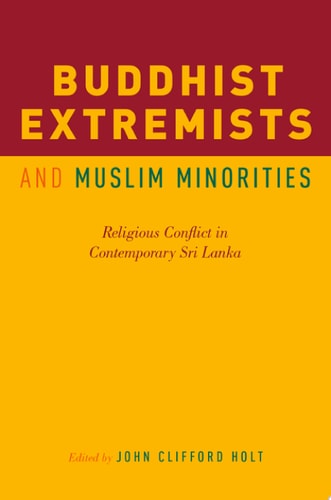
Buddhist Extremists and Muslim Minorities: Religious Conflict in Contemporary Sri Lanka
0
0
As an Amazon Associate and affiliate partner, Menrva Books earns from qualifying purchases. Learn more
Author Description
When the civil war in Sri Lanka between Sinhala Buddhists and Tamils ended in 2009, many Sri Lankans and foreign observers alike hoped to see the re-establishment of relatively harmonious religious and ethnic relations among the various communities in the country. Instead, a different type of violence erupted, this time aimed at the Muslim community. The essays in Buddhist Extremists and Muslim Minorities investigate the history and current state of Buddhist-Muslim relations in Sri Lanka, in an attempt to identify the causes of this newly emergent conflict. Euro-American readers unfamiliar with this story will be surprised to learn that it inverts common stereotypes of the two religious groups. In this context, certain groups of Buddhists, generally considered peace-oriented in the West, are engaged in victimizing Muslims, who are increasingly seen as militant. The authors examine the historical contexts and substantive reasons that gave rise to Buddhist nationalism and aggressive attacks on Muslim communities. The rise of Buddhist nationalism in general is analyzed and explained, while the specific role, methods, and character of the militant Bodu Bala Sena ("Army of Buddhist Power") movement receive particular scrutiny. The motivations for attacks on Muslims may include deep-seated perceptions of economic disparity, but elements of religious culture (ritual and symbol) are also seen as catalysts for explosive acts of violence. This much-needed, timely commentary promises to shift the standard narrative on Muslims and religious violence.
Menrva's Summary
THE THESIS
This book investigates the underlying causes and historical developments that triggered violent conflict between Buddhist nationalists and the Muslim minority in post-civil war Sri Lanka. John Clifford Holt, a scholar of Buddhist studies, compiles a series of essays that analyze the socio-political landscape of the country following the 2009 conclusion of the civil war. The contributors utilize historical analysis and contemporary sociological data to challenge Western perceptions of Buddhist pacifism and Muslim militancy, arguing that economic anxieties and religious symbolism serve as primary catalysts for the current unrest.
THE SCOPE MAP
What You Will Find
- Historical context of Buddhist-Muslim relations in Sri Lanka
- Analysis of the Bodu Bala Sena (Army of Buddhist Power) movement
- Examination of economic disparity as a driver for communal violence
- Discussion of ritual and religious symbols in modern nationalist discourse
Scope Limits
- Does not provide a comprehensive history of the preceding Tamil-Sinhala civil war
- Does not offer a policy-based resolution or peace-building framework for the conflict
THE AUTHORITY PERSPECTIVE
Experts identify this collection as a significant contribution to the study of religious nationalism in South Asia. Readers frequently note the academic density of the prose, which provides a rigorous examination of a complex and often overlooked geopolitical issue.
Page Count:
252
Publication Date:
2016-01-01
Publisher:
Oxford University Press
ISBN-10:
019062440X
ISBN-13:
9780190624408
Religion
History
Sociology
Special Topics
Buddhism
Conflict Studies
Sri Lanka
Islam
Asian History
Community Tags
Similar Books