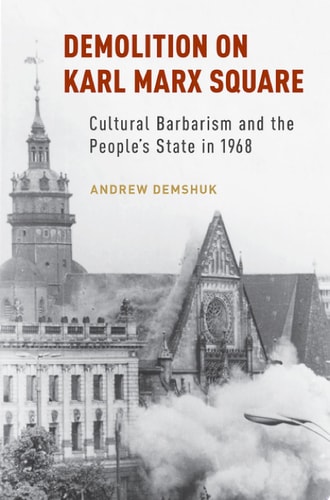
Demolition on Karl Marx Square: Cultural Barbarism and the People's State in 1968
0
0
As an Amazon Associate and affiliate partner, Menrva Books earns from qualifying purchases. Learn more
Author Description
Communist East Germany's demolition of Leipzig's perfectly intact medieval University Church in May 1968 was an act decried as "cultural barbarism" across the two Germanies and beyond. Although overshadowed by the crackdown on Prague Spring mere weeks later, the willful destruction of this historic landmark on a central site symbolically renamed Karl Marx Square represents an essential turning point in the relationship between the Communist authorities and the people they claimed to serve. As the largest case of public protest in East German history between the 1953 Uprising and 1989 Revolution, this intimate local trauma exhibits the inner workings of a "dictatorial" system and exposes the often gray and overlapping lines between state and citizenry, which included both quiet and open resistance, passive and active collaboration. Through deep analysis of untapped periodicals and archives (including once-classified State documents, Stasi, and police records, and extensive private protest letters), it introduces a broad cast of characters who helped make the inconceivable possible, and restores the voices of not a few ordinary citizens of all stripes who dared in the name of culture, humanism, and civic pride to protest what they saw as an inconceivable tragedy. In this city that later started the 1989 October Revolution which ultimately triggered the fall of the Berlin Wall, residents from every social background desperately hoped to convince their leaders to step back from the brink. But as the dust cleared in 1968, they saw with all finality that their voices meant nothing, that the DDR was a sham democracy awash with utopian rhetoric that had no connection with their everyday lives. If Communism died in Prague in 1968, it had already died in Leipzig just weeks before, with repercussions that still haunt today's politics of memory.
Menrva's Summary
THE THESIS
The demolition of Leipzig's University Church in 1968 serves as a critical case study for understanding the widening chasm between the East German state and its citizenry during the Cold War. Author Andrew Demshuk, a historian specializing in modern German history, utilizes this specific event to investigate the failure of the socialist state to maintain legitimacy among its people. By analyzing the protest movement surrounding the church's destruction, the book argues that this act of cultural erasure signaled a terminal loss of faith in the Communist system long before the fall of the Berlin Wall.
THE SCOPE MAP
What You Will Find
- Analysis of the 1968 demolition of the Leipzig University Church.
- Examination of public protest dynamics between the 1953 Uprising and the 1989 Revolution.
- Integration of previously classified Stasi records, police files, and private correspondence.
- A detailed look at the intersection of urban planning, state ideology, and civic identity.
Scope Limits
- The study focuses primarily on the Leipzig event and does not provide a comprehensive history of all East German architectural policies.
- It does not attempt to cover the entirety of the Prague Spring, using it only as a comparative temporal marker.
THE AUTHORITY PERSPECTIVE
Scholars and historians recognize this work as a significant contribution to the study of East German social history and the politics of memory. Readers frequently note the meticulous use of archival evidence to reconstruct the voices of ordinary citizens who resisted state authority.
Page Count:
272
Publication Date:
2017-01-01
Publisher:
Oxford University Press
ISBN-10:
0190645148
ISBN-13:
9780190645144
History
German history
Cultural History
Communism
European History
Special Topics
Community Tags
Similar Books