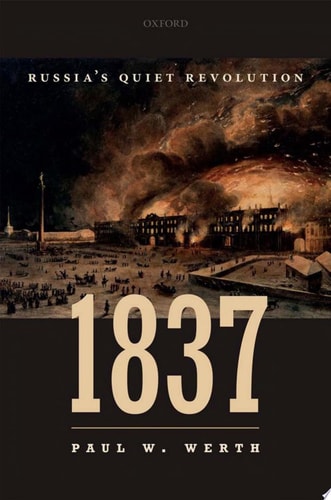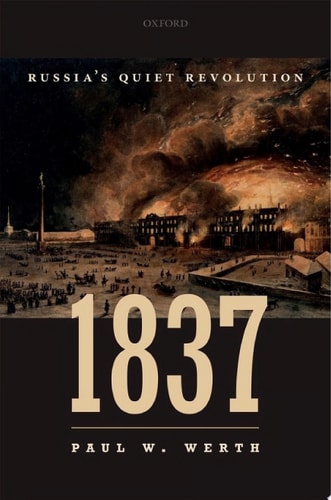
1837: Russia's Quiet Revolution
0
0
As an Amazon Associate and affiliate partner, Menrva Books earns from qualifying purchases. Learn more
Author Description
Historians often think of Russia before the 1860s in terms of conservative stasis, when the "gendarme of Europe" secured order beyond the country's borders and entrenched the autocratic system at home. This book offers a profoundly different vision of Russia under Nicholas I. Drawing on an extensive array of sources, it reveals that many of modern Russia's most distinctive and outstanding features can be traced back to an inconspicuous but exceptional year. Russia became what it did, in no small measure, because of 1837. The catalogue of the year's noteworthy occurrences extends from the realms of culture, religion, and ideas to those of empire, politics, and industry. Exploring these diverse issues and connecting seemingly divergent historical actors, Paul W. Werth reveals that the 1830s in Russia were a period of striking dynamism and consequence, and that 1837 was pivotal for the country's entry into the modern age. From the romantic death of Russia's greatest poet Alexander Pushkin in January to a colossal fire at the Winter Palace in December, Russia experienced much that was astonishing in 1837: the railway and provincial press appeared, Russian opera made its debut, Orthodoxy pushed westward, the first Romanov visited Siberia—and much else besides. The cumulative effect was profound. The country's integration accelerated, and a Russian nation began to emerge, embodied in new institutions and practices, within the larger empire. The result was a quiet revolution, after which Russia would never be the same.
Menrva's Summary
THE THESIS
This book investigates whether the year 1837 served as a pivotal, transformative moment in the modernization of the Russian Empire, challenging the traditional view of the Nicholas I era as one of stagnant conservatism. Paul W. Werth, a specialist in Russian history, utilizes a wide array of archival sources and cultural records to argue that 1837 was a period of intense dynamism. By examining events ranging from the death of Alexander Pushkin to the introduction of railways and the expansion of the provincial press, Werth demonstrates how these disparate developments collectively catalyzed Russia's entry into the modern age.
THE SCOPE MAP
What You Will Find
- Analysis of cultural, religious, and political shifts within the Russian Empire during the 1830s.
- Examination of specific events including the death of Alexander Pushkin, the Winter Palace fire, and the debut of Russian opera.
- Discussion of institutional developments such as the emergence of the provincial press and early railway infrastructure.
Scope Limits
- The analysis is primarily focused on the specific events and consequences occurring within the calendar year 1837.
- The text does not provide a comprehensive biography of Nicholas I or a general history of the entire 19th century.
THE AUTHORITY PERSPECTIVE
Historians recognize this work as a significant re-evaluation of the Nicholas I period, noting the author's ability to synthesize diverse cultural and political data points. Scholars frequently highlight the text for its ability to transform a micro-historical focus into a broader argument about the origins of modern Russian identity.
Page Count:
231
Publication Date:
2021-01-01
Publisher:
OUP Oxford
ISBN-10:
0192560883
ISBN-13:
9780192560889
History
19th Century
Russian History
European History
Eastern Europe
Cultural History
Political History
Community Tags
Similar Books