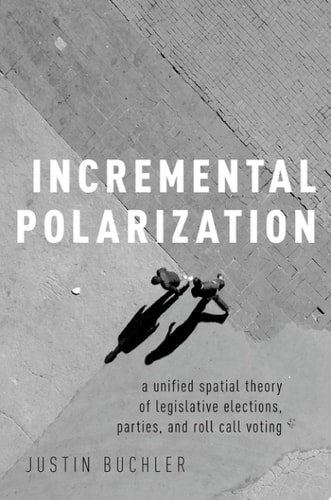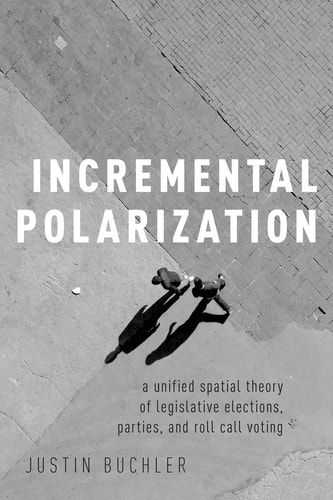
Incremental Polarization: A Unified Spatial Theory of Legislative Elections, Parties and Roll Call Voting
0
0
As an Amazon Associate and affiliate partner, Menrva Books earns from qualifying purchases. Learn more
Author Description
As the last decade has shown, ideological polarization in Congress has reached historic levels. Yet, spatial theory has become increasingly important for how scholars understand Congress and legislative elections. In spatial models, candidates select positions along an ideological spectrum, and voters choose candidates based on those locations. However, the central tendency of these models is for the candidates to converge to the location of the median voter, so polarization has become increasingly problematic for spatial theory, even as scholars have come to rely increasingly on these models. In Incremental Polarization, Justin Buchler provides a unified spatial model of legislative elections, parties, and roll call voting to explain the development of polarization in Congress. His model moves beyond elections and factors in legislators' roll call voting, where a different but related spatial process operates. By linking these models, Incremental Polarization fills a critical gap in our understanding of the strategic, electoral, and procedural roots of polarization-and the role that parties play in the process.
Menrva's Summary
THE THESIS
This book investigates the paradox of why ideological polarization in Congress continues to rise despite traditional spatial models predicting candidate convergence toward the median voter. Justin Buchler, a political scientist specializing in legislative behavior, constructs a unified spatial framework that integrates electoral strategy with roll call voting patterns. By linking these two distinct but related processes, the author argues that party influence and procedural dynamics are the primary drivers of the observed ideological divergence in American politics.
THE SCOPE MAP
What You Will Find
- A unified spatial model connecting legislative elections to roll call voting behavior
- Analysis of party influence on candidate positioning and legislative outcomes
- Theoretical explanations for the failure of median voter convergence in modern Congress
Scope Limits
- The model focuses primarily on the United States Congress and may not account for parliamentary systems or non-US legislative bodies
- The text prioritizes theoretical and mathematical modeling over qualitative historical narrative
THE AUTHORITY PERSPECTIVE
Scholars and political scientists recognize this work as a significant contribution to the formal study of legislative behavior and polarization. Readers frequently note the academic density of the prose, which is best suited for those with a background in political science or formal modeling.
Page Count:
208
Publication Date:
2018-05-30
Publisher:
Oxford University Press
ISBN-10:
0190865598
ISBN-13:
9780190865597
Voting
Public Policy
Elections
American Government
Political Theory
Legislative Studies