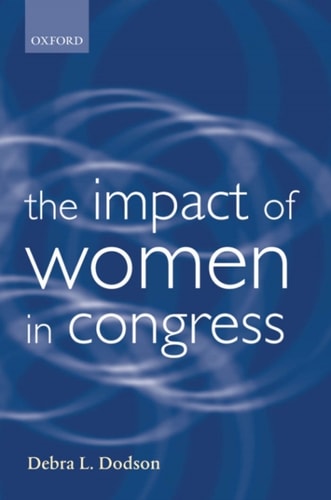
The Impact of Women in Congress
0
0
As an Amazon Associate and affiliate partner, Menrva Books earns from qualifying purchases. Learn more
Author Description
While existing literature provides compelling evidence that women in public office make a difference, the relationship between descriptive and substantive representation of women in political institutions long the domain of men is neither simple nor certain. Embracing New Institutionalists' warnings of the dangers of studying behaviour in an institutional vacuum, this book uses two strikingly different yet consecutive congresses - the Democratically controlled 103rd Congress elected during the 'Year of the Woman' and the Republican-controlled 104th Congress elected during the 'Year of the Angry White Male' - as laboratories to explore the complexity of the relationship between women's presence and impact. In-depth interviews with hundreds of staff, lobbyists, and women members of Congress, along with other quantitative and archival data, are the foundation for case studies of three highly visible policy areas (reproductive rights, women's health, and health care policy) important to women, but with strikingly different outcomes across the two Congresses. The inquiry is quickly moved beyond the simple question 'Do women make a difference?' Dodson confronts the contested issues surrounding difference which often lurk beneath the surface - the probabilistic rather than deterministic relationship between descriptive and substantive representation of women, the contested legitimacy of women representing women, and the disagreement about what it means to represent women. The analysis moves the literature toward a better integrated understanding of how gendered forces at the individual, institutional, and societal levels combine to reinforce and redefine gendered relationships to power in the public sphere. The results can be generalized over time and across settings, are meaningful even in periods when the answer to the question of whether women make a difference seems to be more frequently 'no' than 'yes,' and point to strategies that may bolster the impact of women's presence.
Menrva's Summary
THE THESIS
This book investigates the complex, non-deterministic relationship between the descriptive presence of women in legislative bodies and their substantive impact on policy outcomes. Author Debra L. Dodson, a political scientist, utilizes a framework grounded in New Institutionalism to argue that gendered forces at the individual, institutional, and societal levels interact to shape political influence. By examining two distinct congressional sessions, she moves beyond binary questions of whether women make a difference to analyze the conditions under which their representation translates into policy change.
THE SCOPE MAP
What You Will Find
- Comparative analysis of the 103rd and 104th United States Congresses.
- Case studies focusing on reproductive rights, women's health, and general health care policy.
- Integration of qualitative interview data with quantitative and archival records.
Scope Limits
- The study is primarily focused on the American legislative context during the mid-1990s.
- It does not provide a comprehensive history of women in global politics or non-legislative executive roles.
THE AUTHORITY PERSPECTIVE
Scholars and political analysts frequently cite this work as a foundational text for understanding the nuances of substantive representation in institutional settings. Readers often note the academic rigor of the methodology and the clarity with which Dodson navigates the complexities of gendered power dynamics.
Page Count:
312
Publication Date:
2006-01-01
Publisher:
Oxford University Press
ISBN-10:
0191522759
ISBN-13:
9780191522758
Gender Studies
Women In Politics
United States
Political Activity
Legislative Studies
American Government
Public Policy
Community Tags
Other Editions(2)
Similar Books






Reader Comments
Share Your Thoughts
No comments yet. Be the first to share your thoughts!