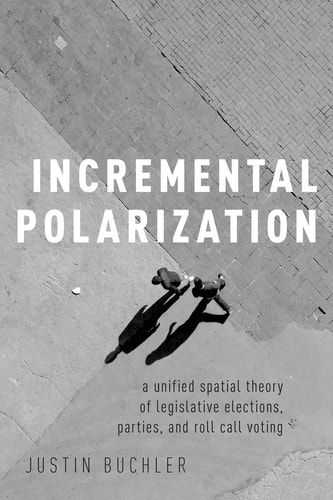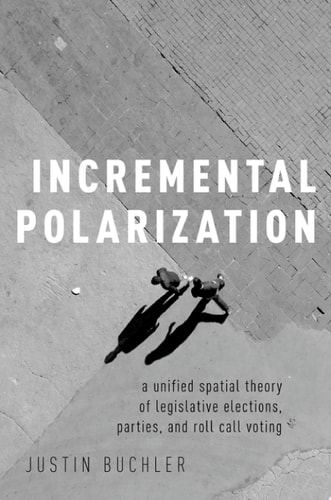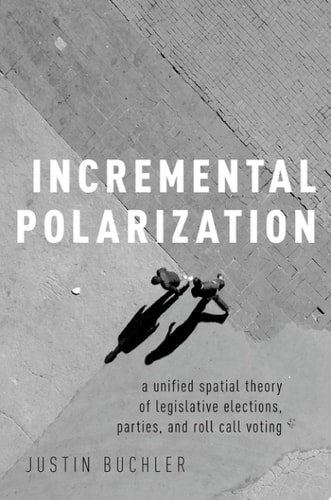
Incremental Polarization: A Unified Spatial Theory of Legislative Elections, Parties and Roll Call Voting
0
0
As an Amazon Associate and affiliate partner, Menrva Books earns from qualifying purchases. Learn more
Author Description
As the last decade has shown, ideological polarization in Congress has reached historic levels. Yet, spatial theory has become increasingly important for how scholars understand Congress and legislative elections. In spatial models, candidates select positions along an ideological spectrum, and voters choose candidates based on those locations. However, the central tendency of these models is for the candidates to converge to the location of the median voter, so polarization has become increasingly problematic for spatial theory, even as scholars have come to rely increasingly on these models. In Incremental Polarization, Justin Buchler provides a unified spatial model of legislative elections, parties, and roll call voting to explain the development of polarization in Congress. His model moves beyond elections and factors in legislators' roll call voting, where a different but related spatial process operates. By linking these models, Incremental Polarization fills a critical gap in our understanding of the strategic, electoral, and procedural roots of polarization-and the role that parties play in the process.
Menrva's Summary
THE THESIS
How can spatial theory account for the persistent and increasing ideological polarization within the United States Congress? Justin Buchler, a scholar of American politics, addresses the limitations of traditional spatial models that predict candidate convergence toward the median voter. He proposes a unified framework that integrates electoral behavior with legislative roll call voting to demonstrate how strategic party incentives drive polarization beyond simple voter preference alignment.
THE SCOPE MAP
What You Will Find
- A unified spatial model linking electoral competition to legislative behavior.
- Analysis of the procedural and strategic roles of political parties in Congress.
- Examination of the divergence between candidate positioning and roll call voting patterns.
Scope Limits
- The analysis focuses primarily on the United States legislative system and may not apply to parliamentary systems with different electoral structures.
- The book does not provide a comprehensive history of all legislative sessions but focuses on the theoretical mechanisms of polarization.
THE AUTHORITY PERSPECTIVE
Scholars in the field of legislative studies recognize this work as a significant attempt to reconcile spatial theory with the observed reality of partisan divergence. Readers frequently note the technical density of the prose, which assumes a foundational understanding of formal modeling and political science methodology.
Page Count:
203
Publication Date:
2018-01-01
Publisher:
Oxford University Press
ISBN-10:
019086561X
ISBN-13:
9780190865610
Public Policy
Spatial Theory
Legislative Studies
Public Administration
American Government