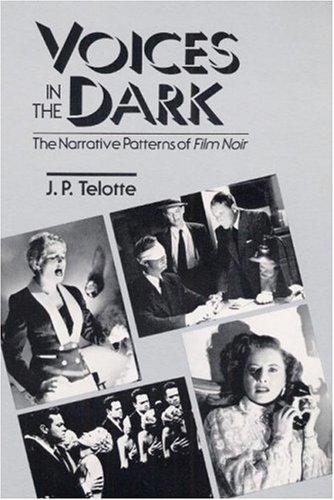
Voices in the Dark
0
0
As an Amazon Associate and affiliate partner, Menrva Books earns from qualifying purchases. Learn more
Author Description
From the Back Cover: The American film noir, the popular genre that focused on urban crime and corruption in the 1940s and 1950s, exhibits the greatest amount of narrative experimentation in the modern American cinema. Spurred by postwar disillusionment, cold war anxieties, and changing social circumstances, these films revealed the dark side of American life and, in doing so, created unique narrative structures in order to speak of that darkness. J.P. Telotte's in-depth discussion of classic films noir-including The Lady from Shanghai, The Lady in the Lake, Dark Passage, Double Indemnity, Kiss Me Deadly, and Murder, My Sweet-draws on the work of Michel Foucault to examine four dominant noir narrative strategies.
Menrva's Summary
THE THESIS
This book investigates the unique narrative strategies employed by American film noir to articulate the genre's pervasive themes of urban crime, corruption, and the dark side of American life. J. P. Telotte, drawing on the work of Michel Foucault, analyzes how postwar disillusionment and changing social circumstances spurred narrative experimentation in classic film noir. The study focuses on four dominant narrative strategies evident in films such as The Lady from Shanghai, The Lady in the Lake, Dark Passage, Double Indemnity, Kiss Me Deadly, and Murder, My Sweet. Telotte's examination reveals how these structural choices were integral to the genre's exploration of societal darkness.
THE SCOPE MAP
- Analysis of narrative experimentation in American film noir from the 1940s and 1950s.
- Application of Michel Foucault's theories to cinematic narrative structures.
- In-depth discussion of specific film noir titles including The Lady from Shanghai, The Lady in the Lake, Dark Passage, Double Indemnity, Kiss Me Deadly, and Murder, My Sweet.
- Examination of four dominant narrative strategies characteristic of the film noir genre.
- Exploration of how film noir reflected postwar disillusionment, cold war anxieties, and evolving social circumstances.
- Focus on the genre's unique methods for depicting the 'dark side' of American life.
THE AUTHORITY PERSPECTIVE
This scholarly work is recognized for its rigorous application of critical theory to a significant cinematic movement. Telotte's analysis is noted for its depth in dissecting the formal qualities of film noir, particularly its narrative structures, and for connecting these to broader cultural anxieties of the mid-20th century. The book is considered a valuable resource for students and scholars of film studies and American cultural history. Its examination of specific films provides concrete examples to support its theoretical framework.
Page Count:
248
Publication Date:
1989-01-01
ISBN-10:
0252060563
History
Non-Fiction
Cultural History
Film Studies
Literary Criticism
American Cinema
Community Tags
Similar Books