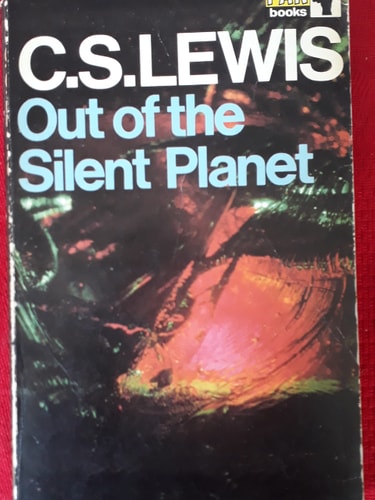
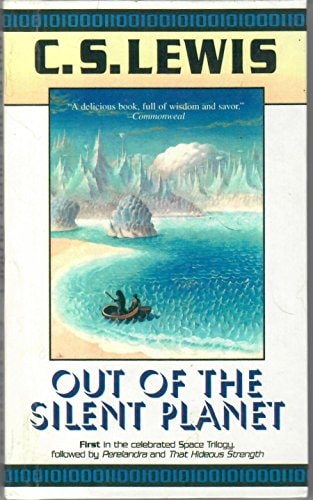
Out of the Silent Planet
0
0
As an Amazon Associate and affiliate partner, Menrva Books earns from qualifying purchases. Learn more
Author Description
Written during the dark hours immediately before and during the Second World War, C. S. Lewis's Space Trilogy, of which Out of the Silent Planet is the first volume, stands alongside such works as Albert Camus's The Plague and George Orwell's 1984 as a timely parable that has become timeless, beloved by succeeding generations as much for the sheer wonder of its storytelling as for the significance of the moral concerns. For the trilogy's central figure, C. S. Lewis created perhaps the most memorable character of his career, the brilliant, clear-eyed, and fiercely brave philologist Dr. Elwin Ransom. Appropriately, Lewis modeled Dr. Ransom after his dear friend J. R. R. Tolkien, for in the scope of its imaginative achievement and the totality of its vision of not one but two imaginary worlds, the Space Trilogy is rivaled in this century only by Tolkien's trilogy The Lord of the Rings. Readers who fall in love with Lewis's fantasy series The Chronicles of Namia as children unfailingly cherish his Space Trilogy as adults; it, too, brings to life strange and magical realms in which epic battles are fought between the forces of light and those of darkness. But in the many layers of its allegory, and the sophistication and piercing brilliance of its insights into the human condition, it occupies a place among the English language's most extraordinary works for any age, and for all time.Out of the Silent Planet introduces Dr. Ransom and chronicles his abduction by a megalomaniacal physicist and his accomplice via space ship to the planet Malacandra. The two men are in need of a human sacrifice and Dr. Ransom would seem to fit the bill. Dr. Ransom escapes upon landing, though, and goes on the run, a stranger in a land that, like Jonathan Swift's Lilliput, is enchanting in its difference from Earth and instructive in its similarity.
Menrva's Summary
THE PULSE
Dr. Elwin Ransom, a philologist, is abducted by two men and transported to the planet Malacandra, where he must navigate an alien landscape while evading his captors. Ransom finds himself a stranger in a world governed by laws and beings entirely foreign to his own experience, forcing him to rely on his linguistic skills and moral compass to survive. The narrative, presented through a third-person perspective, follows his struggle to comprehend the complex social and spiritual hierarchy of the planet. As he encounters the inhabitants of Malacandra, he is confronted with the stark contrast between their harmonious existence and the destructive, materialistic motivations of his human abductors.
INSIDE THE PAGES
- Exploration of linguistic communication as a bridge between species
- Allegorical critique of human imperialism and technological hubris
- Detailed world-building of the planet Malacandra and its three distinct species
- Thematic focus on the spiritual and moral state of Earth, referred to as the Silent Planet
- Third-person limited narrative perspective focusing on Ransom's internal observations
- Philosophical dialogue regarding the nature of good and evil
- Contrast between the naturalistic, harmonious alien society and the industrial, cold logic of the antagonists
- Use of speculative biology to define the physical constraints of the alien environment
THE COLLECTIVE ECHO
This work is widely regarded as a foundational text in twentieth-century speculative fiction, noted for its intellectual depth and theological underpinnings. Critics often highlight the contrast between the imaginative scope of the alien world and the grounded, often critical, perspective on human nature that Lewis maintains throughout the narrative. The prose is frequently praised for its clarity and the way it balances traditional adventure tropes with complex philosophical inquiry. Readers often find that the book serves as a bridge between classic literature and modern science fiction, offering a unique perspective on the human condition that remains relevant across generations.
Page Count:
176
Publication Date:
1938-01-01
Publisher:
Voyager/Harper Collins
ISBN-10:
0006281656
ISBN-13:
9780006281658
Adventure
Science Fiction
Science & Math
Literature & Fiction
Literary
Adventure
Science Fiction
classic
Philosophical
Community Tags
Other Editions(6)

Similar Books











Reader Comments
Share Your Thoughts
No comments yet. Be the first to share your thoughts!