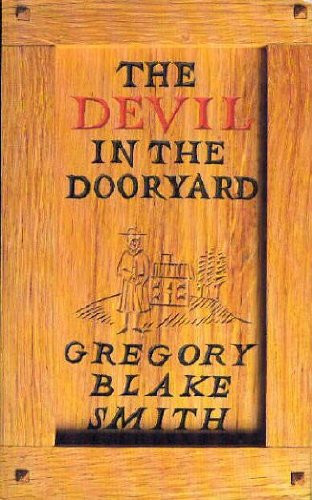
The Devil in the Dooryard
0
0
As an Amazon Associate and affiliate partner, Menrva Books earns from qualifying purchases. Learn more
Author Description
Smith's ambitious, experimental first novel takes its title from the writings of the preacher and moralist Cotton Mather. Using several other 17th century American narrativesi.e., a "Description of New England" and an Indian captivityas models and subtexts, protagonist John Wheelwright, who calls himself "Wright," inveighs in the spirit of a Puritan divine against today's evils of abortion, infidelity, shoddy architecture, game shows and female vanity, to name a few. Wright, assuming the identity of a young cabinetmaker and historian of colonial Massachusetts, does not always succeed in interesting his wife, Hetty, in his archeological digs or his communications with long-dead ancestors and the Wampanoag sachem King Philip. Hetty's main concern is her professional guardianship of a pair of autistic twins, whose plight reflects the fallen world. As it shuttles between the past and present, tracing current American woes to the prophecies of our Anglican and Puritan forefathers, the novel is too didactic, too stuffed with lengthily quoted literary passages and moral outrage to seize the reader's sympathetic attention. Smith is capable of writing very well, but this novel misfires.Copyright 1986 Reed Business Information, Inc.
Menrva's Summary
THE PULSE
A man obsessed with the moral decay of modern society adopts the persona of a 17th-century Puritan to critique the present through the lens of the past. John Wheelwright, who styles himself as "Wright," attempts to reconcile his fixation on colonial history and the prophecies of Cotton Mather with his crumbling domestic life. His wife, Hetty, remains detached from his intellectual pursuits, focusing instead on her work with autistic twins, which serves as a grounding counterpoint to Wright's abstract moralizing. The narrative oscillates between historical reenactment and contemporary reality, utilizing a complex, multi-layered structure that forces the reader to navigate the protagonist's shifting identity and his increasingly frantic attempts to impose order on a chaotic world.
INSIDE THE PAGES
- Non-linear narrative structure shifting between the 17th century and the present day
- Extensive use of historical subtexts including "Description of New England" and captivity narratives
- First-person perspective characterized by the voice of a Puritan divine
- Integration of primary source material and literary quotations from Cotton Mather
- Exploration of the intersection between historical obsession and modern domestic failure
- Thematic focus on the decline of American moral and architectural standards
- Symbolic representation of the "fallen world" through the plight of autistic characters
- Experimental prose style that blends academic historical inquiry with contemporary social critique
THE COLLECTIVE ECHO
Critical reception of this work highlights the tension between the author's technical skill and the narrative's structural density. Reviewers have noted that the heavy reliance on didactic moralizing and lengthy literary quotations often obscures the emotional core of the story. While the ambition of the experimental framework is acknowledged, the consensus suggests that the protagonist's relentless outrage creates a barrier for the reader. The novel is frequently characterized as an intellectual exercise that struggles to balance its historical research with the demands of a compelling narrative arc. Consequently, the work is often viewed as a challenging, if uneven, exploration of American identity and historical continuity.
Page Count:
336
Publication Date:
1986-01-01
Publisher:
Flamingo Agencies Ltd.
ISBN-10:
000654228X
ISBN-13:
9780006542285
Literary Fiction
Contemporary
Historical Fiction
Contemporary
Experimental
Literature & Fiction