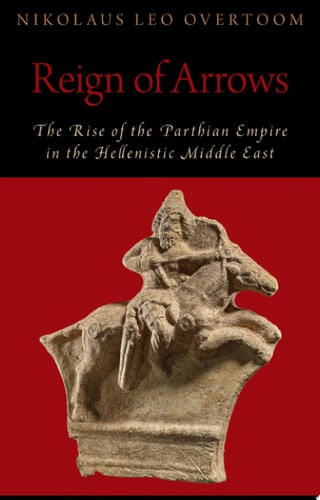
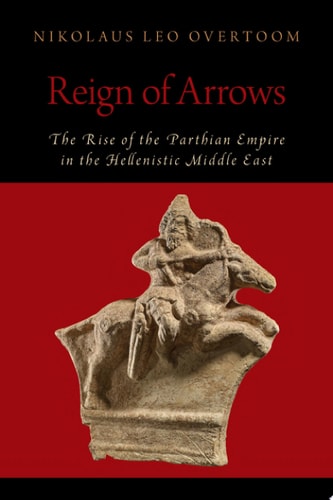
Reign of Arrows: The Rise of the Parthian Empire in the Hellenistic Middle East
0
0
As an Amazon Associate and affiliate partner, Menrva Books earns from qualifying purchases. Learn more
Author Description
From its origins as a minor nomadic tribe to its status as a major world empire, the rise of the Parthian state in the ancient world is nothing short of remarkable. In their early history, the Parthians benefitted from strong leadership, a flexible and accommodating cultural identity, and innovative military characteristics that allowed them to compete against and even overcome Greek, Persian, Central Asian, and eventually Roman rivals. Reign of Arrows provides the first comprehensive study, in almost a century, dedicated entirely to early Parthian history. Assimilating a wide array of especially recent scholarship across numerous fields of study, Nikolaus Overtoom presents the most cogent, well rounded, and up-to-date account of the Parthian empire in its wider context of Hellenistic history. It explains the political and military encounters that shaped the international environment of the Hellenistic Middle East from the middle third to the early first centuries BCE. This study combines traditional historical approaches, such as source criticism and the integration of material evidence, with the incorporation of modern international relations theory to better examine the emergence and expansion of Parthian power. Relevant to historians, classicists, political scientists, and general readers interested in the ancient world and military history, Reign of Arrows reimagines and reconstructs the rise of the Parthians within the hotly contested and dangerously competitive international environment of the Hellenistic world.
Menrva's Summary
THE THESIS
How did a minor nomadic tribe transform into a major world empire capable of challenging the established powers of the Hellenistic Middle East? Nikolaus Leo Overtoom, a specialist in ancient history, synthesizes recent archaeological findings and classical scholarship to analyze the Parthian state's rapid expansion. He argues that the Parthians utilized a combination of adaptive cultural identity, strategic military innovation, and sophisticated political maneuvering to navigate the volatile international environment of the third to first centuries BCE. By applying modern international relations theory to ancient source material, the author provides a framework for understanding the mechanisms of Parthian state-building.
THE SCOPE MAP
What You Will Find
- Analysis of the political and military evolution of the Parthian state from the mid-third to early first centuries BCE.
- Integration of international relations theory to interpret ancient geopolitical power dynamics.
- Examination of Parthian interactions with Greek, Persian, Central Asian, and Roman rivals.
Scope Limits
- The study focuses primarily on the early formation and expansion of the empire rather than its later decline or the entirety of its existence.
- The text prioritizes political and military history over detailed social or domestic cultural history.
THE AUTHORITY PERSPECTIVE
Scholars and historians recognize this work as a significant contribution to the field, noting that it fills a long-standing gap in comprehensive studies of early Parthian history. Readers frequently highlight the author's ability to balance traditional source criticism with modern theoretical frameworks, making it a valuable resource for both academic researchers and students of the ancient world.
Page Count:
392
Publication Date:
2020-01-01
Publisher:
Oxford University Press
ISBN-10:
0190888342
ISBN-13:
9780190888343
History
Ancient History
English
Middle Eastern
English & College Success
Military History
Community Tags
Other Editions(3)
Similar Books



Reader Comments
Share Your Thoughts
No comments yet. Be the first to share your thoughts!