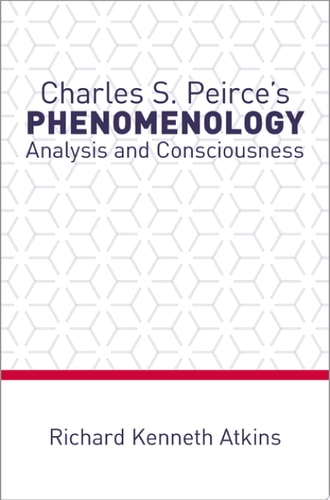
Charles S. Peirce's Phenomenology
0
0
As an Amazon Associate and affiliate partner, Menrva Books earns from qualifying purchases. Learn more
Author Description
No Reasonable Person Would Deny That The Sound Of A Falling Pin Is Less Intense Than The Feeling Of A Hot Poker Pressed Against The Skin, Or That The Recollection Of Something Seen Decades Earlier Is Less Vivid Than Beholding It In The Present. Yet John Locke Is Quick To Dismiss A Blind Man's Report That The Color Scarlet Is Like The Sound Of A Trumpet, And Thomas Nagel Similarly Avers That Such Loose Intermodal Analogies Are Of Little Use In Developing An Objective Phenomenology. Charles Sanders Peirce (1839-1914), By Striking Contrast, Maintains Rather That The Blind Man Is Correct. Peirce's Reasoning Stems From His Phenomenology, Which Has Received Little Attention As Compared With His Logic, Pragmatism, Or Semiotics. Peirce Argues That One Can Describe The Similarities And Differences Between Such Experiences As Seeing A Scarlet Red And Hearing A Trumpet's Blare Or Hearing A Falling Pin And Feeling A Hot Poker. Drawing On The Kantian Idea That The Analysis Of Consciousness Should Take As Its Guide Formal Logic, Peirce Contends That We Can Construct A Table Of The Elements Of Consciousness, Just As Dmitri Mendeleev Constructed A Table Of The Chemical Elements. By Showing That The Elements Of Consciousness Fall Into Distinct Classes, Peirce Makes Significant Headway In Developing The Very Sort Of Objective Phenomenology Which Vindicates The Studious Blind Man Locke So Derides. Charles S. Peirce's Phenomenology Shows How His Phenomenology Rests On His Logic, Gives An Account Of Peirce's Phenomenology As Science, And Then Shows How His Work Can Be Used To Develop An Objective Phenomenological Vocabulary. Ultimately, Richard Kenneth Atkins Shows How Peirce's Pioneering And Distinctive Formal Logic Led Him To A Phenomenology That Addresses Many Of The Questions Philosophers Of Mind Continue To Raise Today.
Menrva's Summary
THE THESIS
This book investigates the core question of whether an objective phenomenology can be constructed by applying the principles of formal logic to the elements of human consciousness. Richard Kenneth Atkins, a scholar of Peircean philosophy, examines the often-overlooked phenomenological framework developed by Charles Sanders Peirce. By analyzing Peirce's assertion that experiences across different sensory modalities share structural similarities, the author demonstrates how Peirce sought to categorize the elements of consciousness with the same rigor Mendeleev applied to the periodic table. The text argues that Peirce's logical foundations provide a viable path for modern philosophers of mind to address long-standing questions regarding subjective experience.
THE SCOPE MAP
What You Will Find
- A detailed examination of the relationship between Peircean logic and his phenomenological theory.
- An analysis of Peirce's methodology for classifying the elements of consciousness.
- A framework for developing an objective phenomenological vocabulary based on formal logic.
- Comparisons between Peircean thought and the views of John Locke and Thomas Nagel.
Scope Limits
- The text does not provide a comprehensive biography of Peirce, focusing instead on his specific philosophical contributions to phenomenology.
- It does not attempt to resolve all contemporary debates in the philosophy of mind, but rather provides a Peircean perspective on them.
THE AUTHORITY PERSPECTIVE
Scholars and students of philosophy frequently note the academic density of the prose, which requires a foundational understanding of Peirce's logic and semiotics. Experts highlight this as a significant contribution to the field, as it elevates Peirce's phenomenology to a level of importance comparable to his more widely studied work in pragmatism.
Page Count:
300
Publication Date:
2018-01-01
Publisher:
Oxford University Press
ISBN-10:
0190887184
ISBN-13:
9780190887186
Philosophy
Philosophy history
Logic
Semiotics
Phenomenology
Epistemology
Community Tags
Similar Books