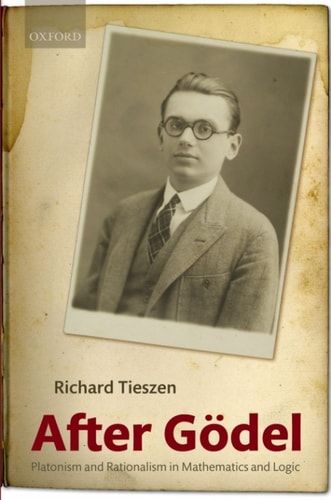
After Godel: Platonism and Rationalism in Mathematics and Logic
0
0
As an Amazon Associate and affiliate partner, Menrva Books earns from qualifying purchases. Learn more
Author Description
Richard Tieszen presents an analysis, development, and defense of a number of central ideas in Kurt Gödel's writings on the philosophy and foundations of mathematics and logic. Tieszen structures the argument around Gödel's three philosophical heroes - Plato, Leibniz, and Husserl - and his engagement with Kant, and supplements close readings of Gödel's texts on foundations with materials from Gödel's Nachlass and from Hao Wang's discussions with Gödel. As well as providing discussions of Gödel's views on the philosophical significance of his technical results on completeness, incompleteness, undecidability, consistency proofs, speed-up theorems, and independence proofs, Tieszen furnishes a detailed analysis of Gödel's critique of Hilbert and Carnap, and of his subsequent turn to Husserl's transcendental philosophy in 1959. On this basis, a new type of platonic rationalism that requires rational intuition, called 'constituted platonism', is developed and defended. Tieszen shows how constituted platonism addresses the problem of the objectivity of mathematics and of the knowledge of abstract mathematical objects. Finally, he considers the implications of this position for the claim that human minds ('monads') are machines, and discusses the issues of pragmatic holism and rationalism.
Menrva's Summary
THE THESIS
How can the philosophical foundations of mathematics be reconciled with the existence of abstract objects and the limits of human cognition? Richard Tieszen, a scholar of phenomenology and the philosophy of mathematics, constructs a defense of 'constituted platonism' by synthesizing the work of Kurt Gödel with the philosophical traditions of Plato, Leibniz, and Husserl. The text evaluates the tension between formalist approaches and rationalist intuition, utilizing Gödel's published writings, his private Nachlass, and documented conversations with Hao Wang to build a coherent metaphysical framework.
THE SCOPE MAP
What You Will Find
- Analysis of Gödel's technical results including incompleteness, undecidability, and consistency proofs.
- A comparative study of the philosophical critiques of Hilbert and Carnap.
- The development of 'constituted platonism' as a response to the problem of mathematical objectivity.
- Examination of the 'mind as machine' hypothesis and the nature of human monads.
Scope Limits
- The text does not provide an introductory overview of mathematical logic for lay readers.
- It does not focus on the historical biography of Gödel beyond his intellectual development.
THE AUTHORITY PERSPECTIVE
Experts recognize this work as a significant contribution to the study of Gödel's later philosophical turn toward Husserlian phenomenology. Readers frequently note the high level of academic density and the requirement for a strong background in both mathematical logic and continental philosophy.
Page Count:
245
Publication Date:
2011-01-01
Publisher:
Oxford University Press
ISBN-10:
0191619310
ISBN-13:
9780191619311
Philosophy
Epistemology
Logic
Mathematics
Logic & Critical Reasoning
Philosophy history
Community Tags
Similar Books