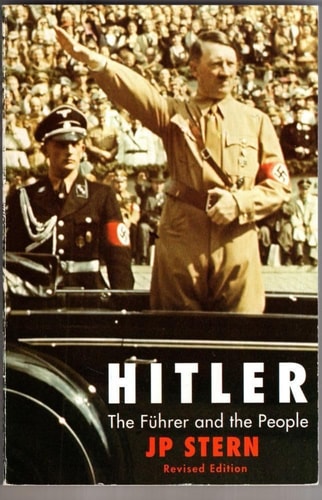
Hitler: The Führer and the People
0
0
As an Amazon Associate and affiliate partner, Menrva Books earns from qualifying purchases. Learn more
Author Description
Professor Stern seeks to expose the roots of the Hitler myth. He performs thoroughly and brilliantly the examination that Kenneth Burke saw as a crying need on the brink of World War II. The questions Professor Stern asks are fundamental and still of the first importance in our own society. How could a predominantly sober, hardworking, and well-educated nation be persuaded to follow Hitler and his inhuman and destructuve program? What was the source of his immense popularity? Why were his public utterances so powerfully persuasive? What were the shared assumptions behind "The Final Solution," Operation Barbarossa, "The Night of the Long Knives"? Professor Stern has done a pioneering study of the rhetoric of Nazism, a rhetoric that coupled words and action. He examines the speeches, writings, and conversations of Hitler and places them in the context of traditional beliefs of the society into which Hitler, the "ideal outsider," made his way. With terrifying logic his career emerges as the creation of a man who translated the private sphere of sentiment into the public sphere of political action, the will to power into a weapon of mass hypnosis.
Menrva's Summary
THE THESIS
This study investigates the mechanisms of mass persuasion and the rhetorical strategies that allowed Adolf Hitler to mobilize a modern, educated nation toward catastrophic inhumanity. Professor J.P. Stern, a scholar of German literature and culture, utilizes a multidisciplinary approach to dissect the intersection of Hitler's private sentiments and his public political actions. By analyzing the language of Nazi propaganda alongside the traditional cultural assumptions of the German populace, the author seeks to explain how a society was conditioned to accept and enact a destructive program of state-sponsored violence.
THE SCOPE MAP
What You Will Find
- A detailed rhetorical analysis of Hitler's speeches, writings, and private conversations.
- An examination of the cultural and historical context of early 20th-century Germany.
- A study of the transition from private sentiment to public political policy.
- An exploration of the psychological and linguistic techniques used to achieve mass influence.
THE AUTHORITY PERSPECTIVE
This work is regarded as a foundational text in the study of Nazi rhetoric, noted for its clinical examination of how language functions as a tool for political manipulation. The analysis provides a dense, academic framework that remains relevant for understanding the mechanics of authoritarian persuasion.
Page Count:
256
Publication Date:
1990-01-01
Publisher:
Fontana
ISBN-10:
0006861954
ISBN-13:
9780006861959
History
Biography
Biography Autobiography
Rhetoric
European History
Heads Of State
Community Tags
Similar Books