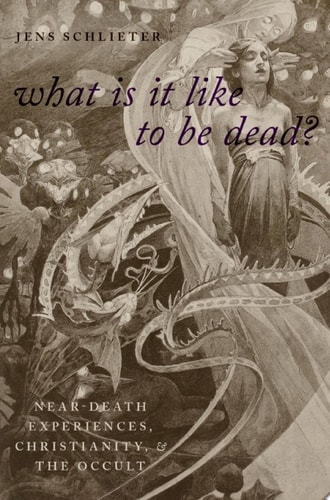
What Is It Like to Be Dead?: Near-Death Experiences, Christianity, and the Occult
0
0
As an Amazon Associate and affiliate partner, Menrva Books earns from qualifying purchases. Learn more
Author Description
Studies of "near-death experiences" show that such experiences not only provide a new certainty of post-mortem survival, but often function as a call for fundamental change in the present. Reported aftereffects encompass changes in attitudes, beliefs, and life orientation. It is said that "experiencers" have lost their fear of death, found their purpose in life, or become "more spiritual." The experience - often declared to be indescribable, inexplicable, or ineffable - is held by many to be the most important of their lives and, moreover, the best proof available for matters "transcendent."In What Is It Like To Be Dead?, Jens Schlieter argues that to understand recent testimonies of near-death experiences, we need to be aware of the history of innumerable reports of earlier near-death experiences that were communicated and handed down in scores of newspapers, journals, and books. Collections of such testimonies have been published for more than 150 years, accompanied by attempts to classify and interpret them. Schlieter analyzes the religious relevance of near-death experiences -for the experiencers themselves, but also for the growing audience attracted by these testimonies. Near-death experiences bear ontological, epistemic, intersubjective, and moral significance, ranging from reassurance that religious experience is still possible to claims that they initiate a new spiritual orientation in life, or offer evidence for the transcultural validity of afterlife beliefs. This study is the first to document and analyze four centuries of near-death testimonies before the codification of the genre in the 1970s, offering the first full account of the modern genealogy of "near-death experiences."
Menrva's Summary
THE THESIS
How have historical accounts of near-death experiences shaped modern religious and spiritual understandings of the afterlife? Jens Schlieter, a scholar of religious studies, examines four centuries of testimonies to argue that contemporary near-death experiences are not isolated modern phenomena but are deeply rooted in a long-standing tradition of reported afterlife encounters. By analyzing how these narratives have been collected, classified, and interpreted over 150 years, Schlieter demonstrates how these experiences function as catalysts for personal transformation and as evidence for transcendent claims.
THE SCOPE MAP
What You Will Find
- A comprehensive historical analysis of near-death testimonies spanning four centuries.
- An examination of the transition from early reports in newspapers and journals to the modern codification of the genre in the 1970s.
- A framework for understanding the ontological and moral significance of afterlife narratives within Christian and occult contexts.
Scope Limits
- The study focuses primarily on Western historical records and does not provide an exhaustive cross-cultural analysis of non-Western afterlife traditions.
- The text prioritizes the history and reception of these reports over clinical or neurological explanations of the experiences themselves.
THE AUTHORITY PERSPECTIVE
Scholars and historians of religion recognize this work as a foundational text for understanding the genealogy of near-death studies. Readers frequently note the academic density of the prose, which provides a rigorous, scholarly approach to a subject often dominated by popular or speculative literature.
Page Count:
376
Publication Date:
2018-01-01
Publisher:
Oxford University Press
ISBN-10:
0190888865
ISBN-13:
9780190888862
Religion
Philosophy
American Religions
Sociology of Religion
History of religion
Agnosticism
Esotericism
Death & dying
Community Tags
Similar Books