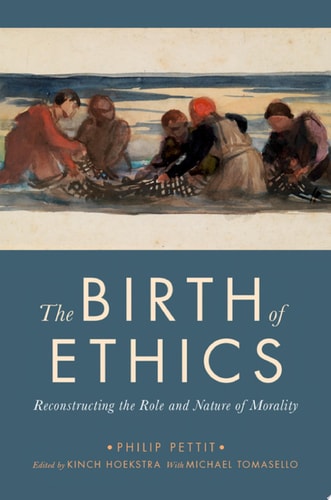
The Birth of Ethics: Reconstructing the Role and Nature of Morality
0
0
As an Amazon Associate and affiliate partner, Menrva Books earns from qualifying purchases. Learn more
Author Description
Imagine a human society, perhaps in pre-history, in which people were generally of a psychological kind with us, had the use of natural language to communicate with one another, but did not have any properly moral concepts in which to exhort one another to meet certain standards and to lodge related claims and complaints. According to The Birth of Ethics, the members of that society would have faced a set of pressures, and made a series of adjustments in response, sufficient to put them within reach of ethical concepts. Without any planning, they would have more or less inevitably evolved a way of using such concepts to articulate desirable patterns of behavior and to hold themselves and one another responsible to those standards. Sooner or later, they would have entered ethical space. While this central claim is developed as a thesis in conjectural history or genealogy, the aim of the exercise is philosophical. Assuming that it explains the emergence of concepts and practices that are more or less equivalent to ours, the story offers us an account of the nature and role of morality. It directs us to the function that ethics plays in human life and alerts us to the character in virtue of which it can serve that function. The emerging view of morality has implications for the standard range of questions in meta-ethics and moral psychology, and enables us to understand why there are divisions in normative ethics like that between consequentialist and Kantian approaches.
Menrva's Summary
THE THESIS
This book investigates the evolutionary and functional origins of morality by reconstructing how human societies might have developed ethical concepts from a pre-moral state. Philip Pettit, a distinguished philosopher, utilizes a framework of conjectural history to argue that ethical systems emerged as necessary adjustments to social pressures. By tracing this hypothetical development, he provides a philosophical account of the nature of morality and its essential role in human life.
THE SCOPE MAP
What You Will Find
- A genealogical model of how moral concepts arise from non-moral social interactions.
- An analysis of the functional requirements for holding individuals responsible for behavior.
- A philosophical examination of the distinction between consequentialist and Kantian normative frameworks.
Scope Limits
- The text does not provide a comprehensive empirical history of specific human cultures.
- It does not offer a definitive resolution to all debates within contemporary meta-ethics.
THE AUTHORITY PERSPECTIVE
Scholars and students of moral philosophy frequently cite this work for its clear, logical progression and its contribution to the field of moral psychology. Experts highlight the text as a rigorous exploration of how normative ethics can be grounded in the practical necessities of human social existence.
Page Count:
400
Publication Date:
2018-01-01
Publisher:
Oxford University Press
ISBN-10:
0190904933
ISBN-13:
9780190904937
Philosophy
Professional Career & Trade
Anthropology
Ethics history
Evolutionary Theory
Ethics
Metaethics
Community Tags
Similar Books