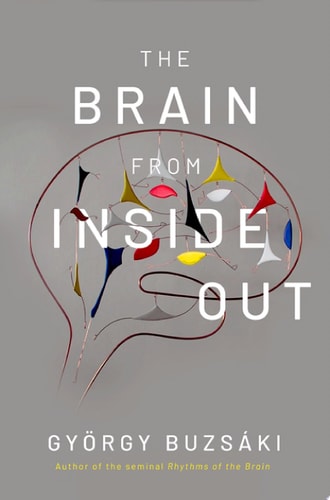
The Brain from Inside Out
0
0
As an Amazon Associate and affiliate partner, Menrva Books earns from qualifying purchases. Learn more
Author Description
Is there a right way to study how the brain works? Following the empiricist's tradition, the most common approach involves the study of neural reactions to stimuli presented by an experimenter. This 'outside-in' method fueled a generation of brain research and now must confront hidden assumptions about causation and concepts that may not hold neatly for systems that act and react.György Buzsáki's The Brain from Inside Out examines why the outside-in framework for understanding brain function has become stagnant and points to new directions for understanding neural function. Building upon the success of 2011's Rhythms of the Brain, Professor Buzsáki presents the brain as a foretelling device that interacts with its environment through action and the examination of action's consequence. Consider that our brains are initially filled with nonsense patterns, all of which are gibberish until grounded by action-based interactions. By matching these nonsense "words" to the outcomes of action, they acquire meaning. Once its circuits are "calibrated" by action and experience, the brain can disengage from its sensors and actuators, and examine "what happens if" scenarios by peeking into its own computation, a process that we refer to as cognition.The Brain from Inside Out explains why our brain is not an information-absorbing coding device, as it is often portrayed, but a venture-seeking explorer constantly controlling the body to test hypotheses. Our brain does not process information: it creates it.
Menrva's Summary
THE THESIS
This book investigates whether the prevailing 'outside-in' paradigm of neuroscience—which views the brain as a passive processor of external stimuli—is fundamentally flawed. György Buzsáki, a distinguished neuroscientist, challenges the traditional empiricist approach by arguing that the brain is an active, self-organizing system. He posits that neural circuits generate internal patterns that acquire meaning only through action and interaction with the environment, effectively turning the brain into a hypothesis-testing device rather than a mere information-absorbing machine.
THE SCOPE MAP
What You Will Find
- A critique of stimulus-response experimental frameworks in modern neuroscience.
- A theoretical model of the brain as a 'foretelling device' that creates rather than processes information.
- Explanations of how internal neural patterns are grounded through motor action and experience.
- Discussion on the transition from sensorimotor interaction to abstract cognition.
Scope Limits
- The text does not provide a comprehensive clinical manual for treating neurological disorders.
- It does not focus on pharmacological interventions or specific neurosurgical techniques.
THE AUTHORITY PERSPECTIVE
Experts recognize this work as a significant theoretical contribution that challenges foundational assumptions in contemporary neuroscience. Readers frequently note the academic density of the prose, which requires a strong background in biological or cognitive sciences to fully grasp the proposed framework.
Page Count:
464
Publication Date:
2019-05-20
Publisher:
Oxford University Press
ISBN-10:
0190905387
ISBN-13:
9780190905385
Non-Fiction
Psychology
Science
Brain
Neuroscience
Community Tags
Similar Books