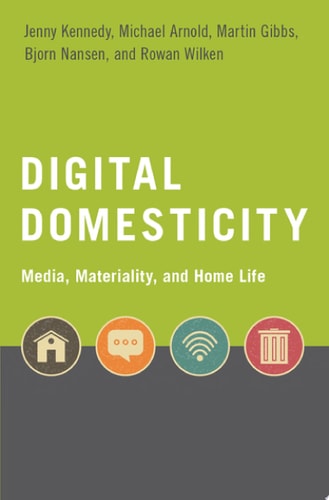
Digital Domesticity: Media, Materiality, and Home Life
0
0
As an Amazon Associate and affiliate partner, Menrva Books earns from qualifying purchases. Learn more
Author Description
At the turn of the twenty-first century, typical households were equipped with a landline telephone, a desktop computer connected to a dial-up modem, and a shared television set. Television, radio and newspapers were the dominant mass media. Today, homes are now network hubs for all manner of digital technologies, from mobile devices littering lounge rooms to Bluetooth toothbrushes in bathrooms--and tomorrow, these too will be replaced with objects once inconceivable. Tracing the origins of these digital developments, Jenny Kennedy, Michael Arnold, Martin Gibbs, Bjorn Nansen, and Rowan Wilken advance media domestication research through an ecology-based approach to the abundance and materiality of media in the home. The book locates digital domesticity through phases of adoption and dwelling, to management and housekeeping, to obsolescence and disposal. The authors synthesize household interviews, technology tours, remote data collection via mobile applications, and more to offer readers groundbreaking insight into domestic media consumption. Chapters use original case studies to empirically trace the adoption, use, and disposal of technology by individuals and families within their homes. The book unearths social and material accounts of media technologies, offering insight into family negotiations regarding technology usage in such a way that puts technology in the context of recent developments of digital infrastructure, devices, and software--all of which are now woven into the domestic fabric of the modern household.
Menrva's Summary
THE THESIS
This book investigates how digital technologies have transformed the modern household into a complex network hub and how these devices are integrated into daily domestic life. The authors, a team of media and technology researchers, utilize an ecology-based framework to analyze the lifecycle of domestic media. By examining the transition from early digital adoption to the eventual obsolescence of devices, they argue that technology is not merely a tool but a fundamental component of the domestic fabric.
THE SCOPE MAP
What You Will Find
- An ecology-based approach to media domestication research.
- Analysis of the lifecycle of technology including adoption, management, and disposal.
- Empirical data regarding family negotiations and technology usage.
Scope Limits
- The text focuses primarily on the domestic sphere and may not address broader industrial or macro-economic implications of digital infrastructure.
THE AUTHORITY PERSPECTIVE
Experts recognize this work as a significant contribution to media domestication studies due to its multi-methodological approach. Readers frequently note the academic rigor and the clarity with which the authors connect material culture to digital infrastructure.
Page Count:
323
Publication Date:
2020-01-01
Publisher:
Oxford University Press
ISBN-10:
0190905816
ISBN-13:
9780190905811
History
Introduction to Human Communication
Technology
Media Studies
Sociology
Earth Sciences
Communications
Community Tags
Similar Books