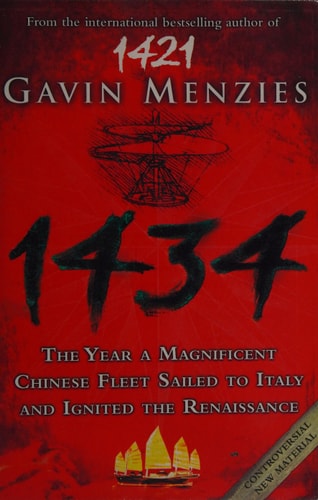
1434: The Year a Chinese Fleet Sailed to Italy and Ignited the Renaissance
0
0
As an Amazon Associate and affiliate partner, Menrva Books earns from qualifying purchases. Learn more
Author Description
In his bestselling book 1421:The Year China Discovered the World, Gavin Menzies revealed that it was the Chinese that discovered America, not Columbus. Now he presents further astonishing evidence that it was also Chinese advances in science, art, and technology that formed the basis of the European Renaissance and our modern world. In his bestselling book 1421: The Year China Discovered the World, Gavin Menzies presented controversial and compelling evidence that Chinese fleets beat Columbus, Cook and Magellan to the New World. But his research has led him to astonishing new discoveries that Chinese influence on Western culture didn't stop there. Until now, scholars have considered that the Italian Renaissance - the basis of our modern Western world - came about as a result of a re-examining the ideas of classical Greece and Rome. A stunning reappraisal of history is about to be published. Gavin Menzies makes the startling argument that a sophisticated Chinese delegation visited Italy in 1434, sparked the Renaissance, and forever changed the course of Western civilization.After that date the authority of Aristotle and Ptolemy was overturned and artistic conventions challenged, as was Arabic astronomy and cartography. Florence and Venice of the 15th century attracted traders from across the world. Menzies presents astonishing evidence that a large Chinese fleet, official ambassadors of the Emperor, arrived in Tuscany in 1434 where they met with Pope Eugenius IV in Florence. A mass of information was given by the Chinese delegation to the Pope and his entourage - concerning world maps (which Menzies argues were later given to Columbus), astronomy, mathematics, art, printing, architecture, steel manufacture, civil engineering, military machines, surveying, cartography, genetics, and more. It was this gift of knowledge that sparked the inventiveness of the Renaissance - Da Vinci's inventions, the Copernican revolution, Galileo, etc. Following 1434, Europeans emb...
Menrva's Summary
THE THESIS
Does the catalyst for the European Renaissance lie in the arrival of a Chinese diplomatic fleet in Italy in 1434? Gavin Menzies, a former submarine commander, utilizes his background in navigation and historical research to challenge the traditional academic consensus regarding the origins of Western intellectual advancement. He argues that the transfer of Chinese scientific, cartographic, and technological knowledge to the Vatican served as the primary spark for the subsequent innovations of figures like Da Vinci and Galileo.
THE SCOPE MAP
What You Will Find
- Analysis of 15th-century maritime trade routes and diplomatic missions between China and Europe.
- Examination of technological transfers in printing, steel manufacture, and civil engineering.
- Comparative study of pre
- and post-1434 European cartography and astronomical records.
- Evidence linking Chinese world maps to the later voyages of European explorers.
THE AUTHORITY PERSPECTIVE
This work is widely regarded by professional historians and academics as pseudohistory, lacking the rigorous evidentiary standards required for historical revisionism. While the author presents a provocative narrative, the consensus among experts remains that the claims are unsupported by primary source documentation and fail to account for the established internal development of European intellectual traditions.
Page Count:
416
Publication Date:
2009-04-30
Publisher:
Harper
ISBN-10:
0007269552
ISBN-13:
9780007269556
History
China
Chinese Influences
Civilization
Italy
World history
Historiography
Renaissance
Europe
Asia
Nonfiction
Maritime history
Community Tags
Other Editions(2)

Similar Books









Reader Comments
Share Your Thoughts
No comments yet. Be the first to share your thoughts!