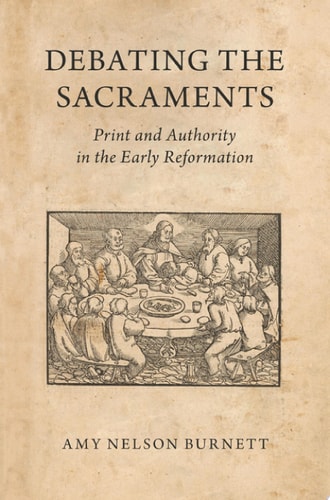
Debating the Sacraments: Print and Authority in the Early Reformation
0
0
As an Amazon Associate and affiliate partner, Menrva Books earns from qualifying purchases. Learn more
Author Description
In Debating the Sacraments, Amy Nelson Burnett brings together the foundational disputes regarding the baptism and the Lord's Supper that laid the groundwork for the development of two Protestant traditions-Lutheran and Reformed-as well as of dissenting Anabaptist movements. Burnett places these disputes in the context of early print culture, tracing their development in a range of publications and their impact on the wider public. Burnett examines not only the writings of the major reformers, but also the reception of their ideas in the pamphlets of lesser known figures, as well as the role of translators, editors, and printers in exacerbating the conflict among both literate and illiterate audiences.Following the chronological unfolding of the debates, Burnett observes how specific arguments were formed in the crucible of written critique and pierces several myths that have governed our understanding of the sacramental controversies. She traces the influence of Erasmus on Luther's followers outside of Wittenberg and highlights the critical question of authority, particularly in interpreting the Bible. Erasmus and Luther disagreed not only about the relationship between the material world and spiritual reality but also on biblical hermeneutics and scriptural exegesis. Their disagreements underlay the public debates over baptism and the Lord's Supper that broke out in 1525 and divided the evangelical movement. Erasmus's position would be reflected not only in the views of Ulrich Zwingli and others who shared his orientation toward the sacraments but also in the developing theologies of the Anabaptist movement of the 1520s.The neglected period of 1525-1529 emerges as a crucial phase of the early Reformation, when evangelical theologies were still developing, and which paved the way for the codification of theological differences in church ordinances, catechisms, and confessions of subsequent decades.
Menrva's Summary
THE THESIS
How did the intersection of early print culture and theological disagreement over the sacraments shape the institutional and ideological divisions of the Protestant Reformation? Amy Nelson Burnett, a scholar of early modern religious history, utilizes a vast array of primary source pamphlets and theological treatises to argue that the sacramental controversies of the 1520s were not merely abstract debates but were actively constructed and disseminated through the mechanisms of the printing press. By examining the interplay between major reformers and lesser-known contributors, Burnett demonstrates how these public disputes established the boundaries of Lutheran, Reformed, and Anabaptist identities.
THE SCOPE MAP
What You Will Find
- Analysis of the sacramental debates concerning baptism and the Lord's Supper between 1525 and 1529.
- Examination of the influence of Erasmus on the development of Zwinglian and Anabaptist theology.
- Investigation into the roles of printers, translators, and editors in shaping public theological discourse.
- Evaluation of the shift from fluid evangelical thought to codified church ordinances and confessions.
Scope Limits
- The study focuses primarily on the German-speaking territories and the specific period of 1525-1529.
- The text does not provide a comprehensive history of the entire Reformation movement beyond the scope of sacramental disputes.
THE AUTHORITY PERSPECTIVE
Scholars recognize this work as a significant contribution to the study of Reformation-era print culture and its role in theological formation. Readers frequently note the academic density of the prose, which provides a rigorous examination of primary source material for those interested in the mechanics of early modern religious debate.
Page Count:
544
Publication Date:
2019-01-17
Publisher:
Oxford University Press
ISBN-10:
0190921188
ISBN-13:
9780190921187
History
Religion
Reformation History
European History
Christian literature
Religious History
Theology
Baptism
Book Industries And Trade
Printing
Reformation
Print Culture
Community Tags
Similar Books