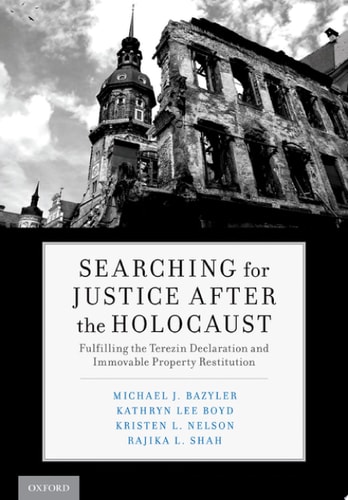
Searching for Justice After the Holocaust: Fulfilling the Terezin Declaration and Immovable Property Restitution
0
0
As an Amazon Associate and affiliate partner, Menrva Books earns from qualifying purchases. Learn more
Author Description
The Nazis and their state-sponsored cohorts stole mercilessly from the Jews of Europe. In the aftermath of the Holocaust, returning survivors had to navigate a frequently unclear path to recover their property from governments and neighbors who had failed to protect them and who often had been complicit in their persecution. While the return of Nazi-looted art has garnered the most media attention, and there have been well-publicized settlements involving stolen Swiss bank deposits and unpaid insurance policies, there is a larger piece of Holocaust injustice that has not been adequately dealt with: stolen land and buildings, much of which today still remain unrestituted. This book is about the less publicized area of post-Holocaust restitution involving immovable (real) property confiscated from European Jews and others during World War II. In 2009, 47 countries convened in Prague to deal with the lingering problem of restitution of pre-war private, communal and heirless property stolen in the Holocaust. The outcome was the issuance by 47 states of the Terezin Declaration on Holocaust Era Assets and Related Issues, which aimed, among other things, to "rectify the consequences" of the wrongful property seizures. This book sets forth the legal history of Holocaust immovable property restitution in each of the Terezin Declaration signatory states. It also analyses how each of the 47 countries has fulfilled the standards of the Guidelines and Best Practices of the Terezin Declaration, issued in 2010 in conjunction with the establishment of the European Shoah Legacy Institute (ESLI) to monitor compliance. The book is based on the Holocaust (Shoah) Immovable Property Restitution Study commissioned by ESLI, written by the authors and issued in Brussels in 2017 before the European Parliament.
Menrva's Summary
THE THESIS
This book investigates the extent to which signatory nations have fulfilled the commitments made in the 2009 Terezin Declaration regarding the restitution of immovable property stolen from Holocaust victims. The authors, a team of legal scholars and researchers, utilize the findings of the Holocaust (Shoah) Immovable Property Restitution Study commissioned by the European Shoah Legacy Institute. They present a comprehensive legal framework to evaluate how 47 countries have addressed the lingering consequences of wartime property seizures and whether their domestic policies align with international best practices.
THE SCOPE MAP
What You Will Find
- A country-by-country legal history of immovable property restitution for all 47 Terezin Declaration signatories.
- An analysis of compliance with the 2010 Guidelines and Best Practices.
- Examination of private, communal, and heirless property recovery processes.
Scope Limits
- The text focuses specifically on immovable (real) property and does not provide an exhaustive account of looted art, bank deposits, or insurance claims.
- It does not cover restitution efforts in nations that were not signatories to the 2009 Terezin Declaration.
THE AUTHORITY PERSPECTIVE
Experts recognize this work as a definitive reference for understanding the legal complexities of post-Holocaust property restitution across Europe. Scholars and policymakers frequently cite the text for its rigorous documentation of state-level compliance and its systematic application of international standards to historical injustice.
Page Count:
567
Publication Date:
2018-01-01
Publisher:
Oxford University Press
ISBN-10:
0190923083
ISBN-13:
9780190923082
History
Human rights
Restitution
European History
Professional Career & Trade
Law
Community Tags
Similar Books












Reader Comments
Share Your Thoughts
No comments yet. Be the first to share your thoughts!