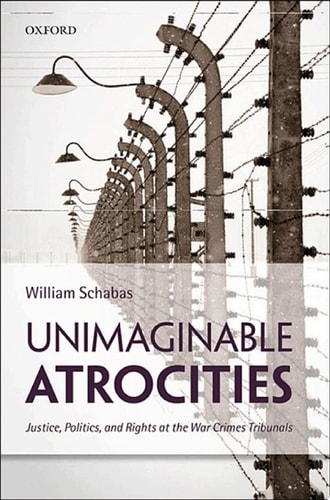
Unimaginable Atrocities: Justice, Politics, and Rights at the War Crimes Tribunals
0
0
As an Amazon Associate and affiliate partner, Menrva Books earns from qualifying purchases. Learn more
Author Description
As international criminal courts and tribunals have proliferated and international criminal law is increasingly seen as a key tool for bringing the world's worst perpetrators to account, the controversies surrounding the international trials of war criminals have grown. War crimes tribunals have to deal with accusations of victor's justice, bad prosecutorial policy and case management, and of jeopardizing fragile peace in post-conflict situations. In this exceptional book, one of the leading writers in the field of international criminal law explores these controversial issues in a manner that is accessible both to lawyers and to general readers. Professor William Schabas begins by considering the discipline of international criminal law, outlining the differing approaches to the description of international crimes and examining the frequent claims relating to the retroactive application of these crimes. The book then discusses the relationship between genocide and crimes against humanity, studying the fascination with what Schabas calls the 'genocide mystique'. International criminal tribunals have often been stigmatized as an exercise in victor's justice. This book traces how this critique developed and the difficulty it poses to the identification of situations for prosecution by the International Criminal Court. The claim that amnesty for international crimes is prohibited by international law is challenged, with a more nuanced approach to the relationship between justice and peace being proposed. Throughout the book there is a strong historical perspective, with constant reference to the early experiments in international justice at Nuremberg and Tokyo. The work also analyses the growing pains of the International Criminal Court as it enters its second decade.
Menrva's Summary
THE THESIS
This work investigates the complex intersection of international criminal law, political legitimacy, and the practical challenges of administering justice in the wake of mass atrocities. Professor William Schabas, a prominent scholar in international criminal law, utilizes a historical and legal framework to evaluate the efficacy and controversies surrounding international tribunals. He argues for a more nuanced understanding of the tension between the pursuit of judicial accountability and the requirements for maintaining peace in post-conflict societies.
THE SCOPE MAP
What You Will Find
- Historical analysis of the Nuremberg and Tokyo trials as foundational precedents.
- Examination of the legal distinctions between genocide and crimes against humanity.
- Critical assessment of the International Criminal Court's operational challenges during its first two decades.
- Evaluation of the debate surrounding amnesty versus prosecution in international law.
Scope Limits
- The text does not provide a comprehensive legal manual for practicing attorneys.
- It does not offer an exhaustive catalog of every international criminal trial in history.
THE AUTHORITY PERSPECTIVE
Legal scholars and practitioners frequently cite this work for its balanced critique of the international justice system. Experts highlight the text as a significant contribution to the discourse on the limitations and political realities of global human rights enforcement.
Page Count:
240
Publication Date:
2012-01-01
Publisher:
OUP Oxford
ISBN-10:
0191612227
ISBN-13:
9780191612220
History
Human rights
War Crime Trials
International Law
Professional Career & Trade
Law
War Crimes
Community Tags
Other Editions(2)
Similar Books
Reader Comments
Share Your Thoughts
No comments yet. Be the first to share your thoughts!