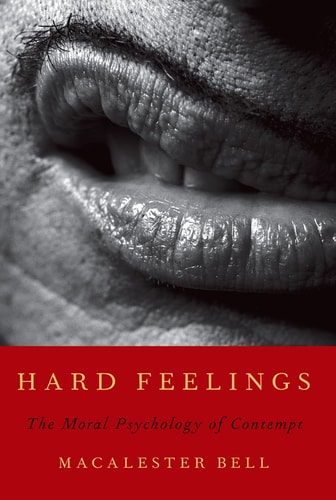
Hard Feelings: The Moral Psychology of Contempt
0
0
As an Amazon Associate and affiliate partner, Menrva Books earns from qualifying purchases. Learn more
Author Description
At a time when respect is widely touted as an attitude of central moral importance, contempt is often derided as a thoroughly nasty emotion inimical to the respect we owe all persons. But while contempt is regularly dismissed as completely disvaluable, ethicists have had very little to say about what contempt is or whether it deserves its ugly reputation. Macalester Bell argues that we must reconsider contempt's role in our moral lives. While contempt can be experienced in inapt and disvaluable ways, it may also be a perfectly appropriate response that provides the best way of answering a range of neglected faults.Using a wide variety of examples, Bell provides an account of the nature of contempt and its virtues and vices. While some insist that contempt is always unfitting because of its globalism, Bell argues that this objection mischaracterizes the person assessments at the heart of contempt. Contempt is, in some cases, the best way of responding to arrogance, hypocrisy, and other vices of superiority. Contempt does have a dark side, and inapt forms of contempt structure a host of social ills. Racism is best characterized as an especially pernicious form of inapt contempt, and Bell's account of contempt helps us better understand the moral badness of racism. It is argued that the best way of responding to race-based contempt is to mobilize a robust counter-contempt for racists.The book concludes with a discussion of overcoming contempt through forgiveness. This account of forgiveness sheds light upon the broader issue of social reconciliation and what role reparations and memorials may play in giving persons reasons to overcome their contempt for institutions.
Menrva's Summary
THE THESIS
Does contempt inherently function as a moral vice, or can it serve as a legitimate and necessary response to specific human failings? Macalester Bell, a philosopher specializing in ethics and moral psychology, challenges the conventional dismissal of contempt as a purely destructive emotion. By analyzing the structural components of contempt, Bell argues that while it can manifest as a social ill, it also functions as a precise moral tool for addressing arrogance and hypocrisy.
THE SCOPE MAP
What You Will Find
- A philosophical framework defining the nature of contempt and its moral status
- An analysis of the relationship between contempt, respect, and social hierarchy
- A detailed examination of racism as a form of inapt, pernicious contempt
- A discussion on the role of forgiveness and social reconciliation
Scope Limits
- The text does not provide a comprehensive psychological study of contempt in clinical settings
- It does not offer a practical self-help guide for emotional regulation
THE AUTHORITY PERSPECTIVE
Scholars and ethicists frequently cite this work as a significant contribution to the study of reactive attitudes and moral emotions. Readers often note the academic density of the prose, which is tailored for those familiar with contemporary moral philosophy.
Page Count:
308
Publication Date:
2018-11-01
Publisher:
Oxford University Press
ISBN-10:
0190929553
ISBN-13:
9780190929558
Non-Fiction
Philosophy
Känslor
Aversioner
Social Philosophy
Ethics
Moral
Community Tags
Similar Books