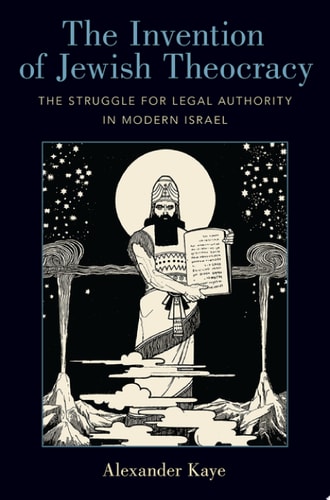
The Invention of Jewish Theocracy: The Struggle for Legal Authority in Modern Israel
0
0
As an Amazon Associate and affiliate partner, Menrva Books earns from qualifying purchases. Learn more
Author Description
The tension between secular politics and religious fundamentalism is a problem shared by many modern states. This is certainly true of the State of Israel, where the religious-secular schism provokes conflict at every level of politics and society. Driving this schism is the idea of the halakhic state, the demand by many religious Jews that Israel should be governed by the law of the Torah as interpreted by Orthodox rabbis. Understanding this idea is a priority for scholars of Israel and for anyone with an interest in its future. The Invention of Jewish Theocracy is the first book in any language to trace the origins of the idea, to track its development, and to explain its crucial importance in Israel's past and present. The book also shows how the history of this idea engages with burning contemporary debates on questions of global human rights, the role of religion in Middle East conflict, and the long-term consequences of European imperialism.The Invention of Jewish Theocracy is an intellectual history, based on newly discovered material from numerous Israeli archives, private correspondence, court records, and lesser-known published works. It explains why the idea of the halakhic state emerged when it did, what happened after it initially failed to take hold, and how it has regained popularity in recent decades, provoking cultural conflict that has severely shaken Israeli society. The book's historical analysis gives rise to two wide-reaching insights. First, it argues that religious politics in Israel can be understood only within the context of the largely secular history of European nationalism and not, as is commonly argued, as an anomalous exception to it. It shows how even religious Jews most opposed to modern political thought nevertheless absorbed the fundamental assumptions of modern European political thought and reread their own religious traditions onto that model. Second, it demonstrates that religious-secular tensions are built into the intellectu
Menrva's Summary
THE THESIS
This book investigates the historical origins and intellectual development of the concept of a halakhic state in Israel, questioning how religious legal authority interacts with modern secular nationalism. Alexander Kaye, a scholar of Jewish history, utilizes archival documents, private correspondence, and court records to argue that the push for a theocratic state is not an anomaly but a product of European nationalist political thought. He demonstrates that even those who reject modern secularism have integrated its fundamental assumptions into their interpretation of religious tradition.
THE SCOPE MAP
What You Will Find
- Historical analysis of the emergence and evolution of the halakhic state concept in Israel.
- Examination of the intersection between religious law and modern European political nationalism.
- Primary source research including previously unexamined archival materials and private correspondence.
Scope Limits
- The text focuses primarily on the intellectual history of the idea rather than a comprehensive sociological survey of contemporary religious practice.
- It does not provide a prescriptive policy guide for resolving current Israeli legislative conflicts.
THE AUTHORITY PERSPECTIVE
Scholars and historians identify this work as a significant contribution to the understanding of modern Israeli political identity. Readers frequently note the academic density of the prose, which provides a rigorous framework for analyzing the intersection of religion and statecraft.
Page Count:
276
Publication Date:
2020-02-19
Publisher:
Oxford University Press
ISBN-10:
0190922745
ISBN-13:
9780190922740
Religion
History
Jewish Studies
Israel Studies
Intellectual History
Asia history
Community Tags
Similar Books