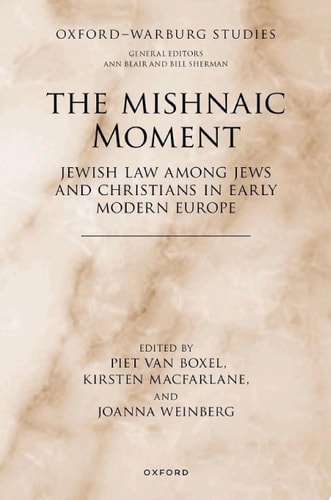
The Mishnaic Moment: Jewish Law among Jews and Christians in Early Modern Europe
0
0
As an Amazon Associate and affiliate partner, Menrva Books earns from qualifying purchases. Learn more
Author Description
This collection of essays treats a topic that has scarcely been approached in the literature on Hebrew and Hebraism in the early modern period. In the seventeenth century, Christians, especially Protestants, studied the Mishnah alongside a host of Jewish commentaries in order to reconstruct Jewish culture, history, and ritual, shedding new light on the world of the Old and New Testaments. Their work was also inextricably dependent upon the vigorous Mishnaic studies of early modern Jewish communities. Both traditions, in a sense, culminated in the monumental production in six volumes of an edition and Latin translation of the Mishnah published by Guilielmus Surenhusius in Amsterdam between 1698 and 1703. Surenhusius gathered up more than a century's worth of Mishnaic studies by scholars from England, Germany, the Netherlands, and Sweden, as well as the commentaries of Maimonides and Obadiah of Bertinoro (c. 1455-c.1515), but this edition was also born out of the unique milieu of Amsterdam at the end of the seventeenth century, a place which offered possibilities for cross-cultural interactions between Jews and Christians. With Surenhusius's great volumes as an end point, the essays presented here discuss for the first time the multiple ways in which the canonical text of Jewish law, the Mishnah (c.200 CE), was studied by a variety of scholars, both Jewish and Christian, in early modern Europe. They tell the story of how the Mishnah generated an encounter between different cultures, faiths, and confessions that would prove to be enduringly influential for centuries to come.
Menrva's Summary
THE THESIS
This collection of essays investigates how the study of the Mishnah served as a critical point of intellectual intersection between Jewish and Christian scholars in early modern Europe. Joanna Weinberg, a scholar of early modern Hebrew studies, examines the collaborative and competitive scholarly environment that facilitated the translation and interpretation of Jewish law. The text argues that the seventeenth-century focus on the Mishnah was not merely an isolated academic pursuit but a foundational element in the development of cross-confessional historical and cultural understanding.
THE SCOPE MAP
What You Will Find
- Analysis of the seventeenth-century intellectual milieu in Amsterdam, England, Germany, and Sweden.
- Examination of the monumental six-volume edition and Latin translation of the Mishnah by Guilielmus Surenhusius.
- Discussion of the influence of Maimonides and Obadiah of Bertinoro on early modern scholarship.
- Primary source analysis of Christian engagement with Hebrew texts to interpret the Old and New Testaments.
Scope Limits
- The text focuses primarily on the seventeenth-century period and does not provide an exhaustive history of Mishnaic study from antiquity to the present.
- The analysis is limited to the specific cross-cultural interactions between Jewish and Christian scholars within the defined European geographic regions.
THE AUTHORITY PERSPECTIVE
Scholars in the field of early modern intellectual history recognize this work as a significant contribution to the study of Hebraism and interfaith academic exchange. Readers frequently note the academic density of the prose and the specialized nature of the historical research presented.
Page Count:
427
Publication Date:
2022-01-01
Publisher:
OUP Oxford
ISBN-10:
0192654314
ISBN-13:
9780192654311
History
Early Modern
Jewish Studies
Theology
Intellectual History
Community Tags
Similar Books