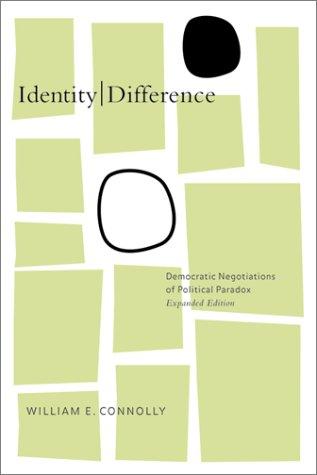
Identity\Difference
0
0
As an Amazon Associate and affiliate partner, Menrva Books earns from qualifying purchases. Learn more
Author Description
In this foundational work in contemporary political theory, William Connolly makes a distinctive contribution to our understanding of the relationship between personal identity and democratic politics, particularly in the domains of religion, ethics, sexuality, and ethnicity. Every identity, Connolly argues, whether individual or social, presents us with a fundamental and troubling paradox: an identity establishes itself in relation to a set of differences, and it operates under powerful pressures to fix, regulate, or exclude some of these differences as otherness. The dignity of a people or political regime, and the quality of democratic culture, depends on the acknowledgment and ethos cultivated in response to these pressures. In a substantial new essay, Connolly responds to the heated controversy surrounding his ideas when Identity\Difference was first published in 1991, while augmenting his discussion of the virtues of critical responsiveness. The issues of identity and difference cannot be ignored, he contends, and are ubiquitous in modern life.
Menrva's Summary
THE THESIS
William Connolly investigates the inherent paradox of identity formation and its implications for democratic societies. Connolly posits that all identities, both individual and social, are defined by their relationship to differences. He argues that these identities are under constant pressure to fix, regulate, or exclude these differences, which he terms 'otherness.' The health of a people or political system, and the quality of its democratic culture, is determined by how these pressures are acknowledged and managed.
THE SCOPE MAP
- Analysis of the relationship between personal identity and democratic politics, focusing on religion, ethics, sexuality, and ethnicity.
- Exploration of the paradox that identities are established in relation to differences.
- Discussion of the pressures to fix, regulate, or exclude differences as 'otherness'.
- Examination of the virtues of critical responsiveness in addressing identity and difference.
- A new essay responding to controversies surrounding the book's initial publication.
THE AUTHORITY PERSPECTIVE
In its initial publication, 'Identity\Difference' sparked significant controversy, prompting Connolly to address these heated debates in a subsequent essay. The book is recognized as a foundational work in contemporary political theory, making a distinctive contribution to understanding the complex interplay between personal identity and democratic politics. Its exploration of how identities are formed through difference and the pressures to exclude 'otherness' remains a critical point of discussion. The enduring relevance of these issues in modern life is underscored by the continued engagement with Connolly's arguments.
Page Count:
244
Publication Date:
2002-01-01
ISBN-10:
0816640866
ISBN-13:
9780816640867
Politics
Non-Fiction
Psychology
Science
Philosophy
Identity politics
Sociology
Democracy
Political Theory
Ethics
Community Tags
Similar Books