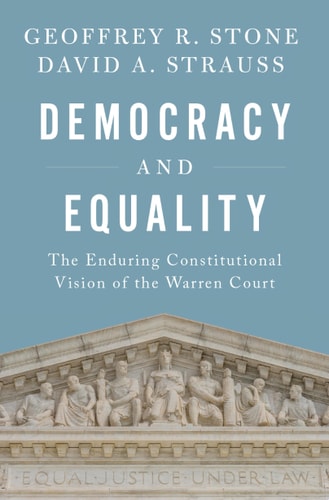
Democracy and Equality: The Enduring Constitutional Vision of the Warren Court
0
0
As an Amazon Associate and affiliate partner, Menrva Books earns from qualifying purchases. Learn more
Author Description
From 1953 to 1969, the Supreme Court under Chief Justice Earl Warren brought about many of the proudest achievements of American constitutional law. The Warren declared racial segregation and laws forbidding interracial marriage to be unconstitutional; it expanded the right of citizens to criticize public officials; it held school prayer unconstitutional; and it ruled that people accused of a crime must be given a lawyer even if they can't afford one. Yet, despite those and other achievements, conservative critics have fiercely accused the justices of the Warren Court of abusing their authority by supposedly imposing their own opinions on the nation.As the eminent legal scholars Geoffrey R. Stone and David A. Strauss demonstrate in Democracy and Equality, the Warren Court's approach to the Constitution was consistent with the most basic values of our Constitution and with the most fundamental responsibilities of our judiciary. Stone and Strauss describe the Warren Court's extraordinary achievements by reviewing its jurisprudence across a range of issues addressing our nation's commitment to the values of democracy and equality. In each chapter, they tell the story of a critical decision, exploring the historical and legal context of each case, the Court's reasoning, and how the justices of the Warren Court fulfilled the Court's most important responsibilities. This powerfully argued evaluation of the Warren Court's legacy, in commemoration of the 50th anniversary of the end of the Warren Court, both celebrates and defends the Warren Court's achievements against almost sixty-five years of unrelenting and unwarranted attacks by conservatives. It demonstrates not only why the Warren Court's approach to constitutional interpretation was correct and admirable, but also why the approach of the Warren Court was far superior to that of the increasingly conservative justices who have dominated the Supreme Court over the past half-century.
Menrva's Summary
THE THESIS
This work investigates whether the jurisprudence of the Warren Court aligns with the fundamental democratic and egalitarian values of the United States Constitution. Authors David A. Strauss and Geoffrey R. Stone, both distinguished legal scholars, utilize historical case analysis and constitutional theory to argue that the Warren Court’s decisions were not instances of judicial overreach, but rather necessary fulfillments of the judiciary’s core responsibilities. They provide a systematic defense of the Court’s legacy against decades of conservative criticism by contextualizing landmark rulings within the broader framework of American constitutional development.
THE SCOPE MAP
What You Will Find
- Analysis of landmark Supreme Court cases from 1953 to 1969 regarding racial segregation, free speech, and criminal procedure.
- A legal framework evaluating judicial interpretation through the lens of democratic equality.
- Historical context surrounding the political climate of the mid-twentieth century.
Scope Limits
- The text does not provide a comprehensive biography of every justice serving during this period.
- It does not offer an exhaustive survey of every minor ruling issued by the Court during the Warren era.
THE AUTHORITY PERSPECTIVE
Legal scholars and historians frequently cite this text as a significant contribution to the ongoing debate regarding judicial philosophy and constitutional interpretation. Experts highlight the authors' ability to synthesize complex legal history into a coherent defense of the Warren Court's institutional role.
Page Count:
227
Publication Date:
2019-01-01
Publisher:
Oxford University Press
ISBN-10:
0190938226
ISBN-13:
9780190938222
History
Professional Career & Trade
Law
United States
Constitutional Law
Community Tags
Other Editions(3)
Similar Books



Reader Comments
Share Your Thoughts
No comments yet. Be the first to share your thoughts!