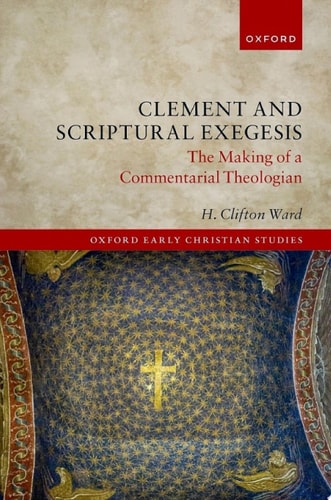
Clement and Scriptural Exegesis: The Making of a Commentarial Theologian
0
0
As an Amazon Associate and affiliate partner, Menrva Books earns from qualifying purchases. Learn more
Author Description
How might one describe early Christian exegesis? This question has given rise to a significant reassessment of patristic exegetical practice in recent decades, and H. Clifton Ward makes a new contribution to this reappraisal of patristic exegesis against the background of ancient Greco-Roman education. In tracing the practices of literary analysis and rhetorical memory in the ancient sources, Clement and Scriptural Exegesis argues that there were two modes of archival thinking at the heart of the ancient exegetical enterprise: the grammatical archive, a repository of the textual practices learned from the grammarian, and the memorial archive, the constellations of textual memories from which meaning is constructed. In a new treatment of the theological exegesis of Clement of Alexandria-the first study of its kind in English scholarship-this study suggests that an assessment of the reading practices that Clement employs from these two ancient archives reveals his deep commitment to scriptural interpretation as the foundation of a theological imagination. Clement employs various textual practices from the grammatical archive to navigate the spectrum between the clarity and obscurity of Scripture, resulting in the striking conclusion that the figurative referent of Scripture is one twofold mystery, bound up in the incarnation of Christ and the higher knowledge of the divine life. This twofold scriptural mystery is discovered in an act of rhetorical invention as Clement reads Scripture to uncover the constellations of texts-about God, Christ, and humanity-that frame its entire narrative.
Menrva's Summary
THE THESIS
How did the educational background of the ancient world shape the exegetical methods of Clement of Alexandria? H. Clifton Ward, a scholar of early Christian history, investigates the intersection of Greco-Roman pedagogical practices and patristic scriptural interpretation. By analyzing the grammatical and memorial archives, the author argues that Clement utilized specific ancient literary techniques to construct a theological framework centered on the incarnation and divine knowledge.
THE SCOPE MAP
What You Will Find
- Analysis of the grammatical archive as a repository for textual practices.
- Examination of the memorial archive and its role in constructing meaning.
- A focused study on the theological exegesis of Clement of Alexandria.
- Exploration of the spectrum between clarity and obscurity in scriptural interpretation.
Scope Limits
- This study does not provide a comprehensive biography of Clement of Alexandria.
- The text does not cover the broader history of post-Clementine Alexandrian theology.
THE AUTHORITY PERSPECTIVE
Scholars recognize this work as a significant contribution to the study of patristic reading practices and the influence of ancient education on Christian thought. Readers frequently note the academic density of the prose, which is intended for specialists in early Christian studies and historical theology.
Page Count:
247
Publication Date:
2022-01-01
Publisher:
OUP Oxford
ISBN-10:
0192678124
ISBN-13:
9780192678126
Religion
History of religion
Bibles
Bible
Patristics
Theology
Classical education
Community Tags
Similar Books