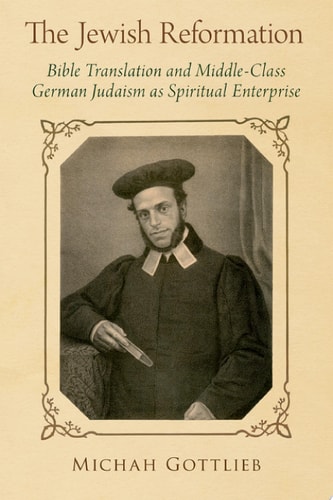
The Jewish Reformation: Bible Translation and Middle-Class German Judaism as Spiritual Enterprise
0
0
As an Amazon Associate and affiliate partner, Menrva Books earns from qualifying purchases. Learn more
Author Description
In the late eighteenth century, German Jews began entering the middle class with remarkable speed. That upward mobility, it has often been said, coincided with Jews' increasing alienation from religion and Jewish nationhood. In fact, Michah Gottlieb argues, this period was one of intense engagement with Jewish texts and traditions. One expression of this was the remarkable turn to Bible translation. In the century and a half beginning with Moses Mendelssohn's pioneering translation and the final one by Martin Buber and Franz Rosenzweig, German Jews produced sixteen different translations of at least the Pentateuch. Exploring Bible translations by Mendelssohn, Leopold Zunz, and Samson Raphael Hirsch, Michah Gottlieb argues that each translator sought a "reformation" of Judaism along bourgeois lines, which involved aligning Judaism with a Protestant concept of religion. Buber and Rosenzweig famously critiqued bourgeois German Judaism as a craven attempt to establish social respectability to facilitate Jews' entry into the middle class through a vapid, domesticated Judaism. But Mendelssohn, Zunz, and Hirsch saw in bourgeois values the best means to serve God and the authentic actualization of Jewish tradition. Through their learned, creative Bible translations, these scholars presented competing visions of middle-class Judaism that affirmed Jewish nationhood while lighting the path to a purposeful, emotionally-rich spiritual life grounded in ethical responsibility.
Menrva's Summary
THE THESIS
This book investigates how German Jewish Bible translations between the late eighteenth and early twentieth centuries served as a vehicle for reforming Judaism to align with emerging middle-class values. Michah Gottlieb, a scholar of Jewish thought, utilizes a historical and textual analysis of sixteen distinct translations to challenge the assumption that upward social mobility among German Jews led to religious alienation. Instead, he argues that figures like Moses Mendelssohn, Leopold Zunz, and Samson Raphael Hirsch viewed bourgeois values as a legitimate framework for authentic spiritual practice and ethical responsibility.
THE SCOPE MAP
What You Will Find
- A historical analysis of sixteen different German Jewish translations of the Pentateuch.
- A comparative study of the theological and social agendas of translators including Mendelssohn, Zunz, and Hirsch.
- An examination of the tension between bourgeois respectability and traditional Jewish nationhood.
- A critique of the Buber-Rosenzweig perspective on the perceived vapidity of middle-class Judaism.
THE AUTHORITY PERSPECTIVE
Scholars recognize this work as a significant contribution to the study of modern Jewish intellectual history and the intersection of religion and social class. Readers frequently note the depth of the author's textual analysis and his ability to reframe the narrative surrounding the German Jewish experience.
Page Count:
474
Publication Date:
2020-01-01
Publisher:
Oxford University Press
ISBN-10:
0199336407
ISBN-13:
9780199336401
Religion
History
Philosophy
Jewish Studies
History & Surveys
German history
Judaism
Religion
Bible
Community Tags
Similar Books