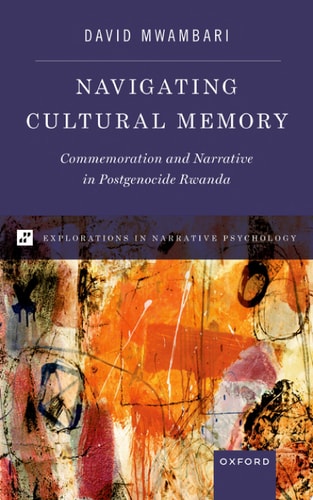
Navigating Cultural Memory: Commemoration and Narrative in Postgenocide Rwanda
0
0
As an Amazon Associate and affiliate partner, Menrva Books earns from qualifying purchases. Learn more
Author Description
Navigating Cultural Memory examines how a master narrative of the 1994 Genocide Against the Tutsi evolved into a hegemonic narrative both in Rwanda and globally. Identifying key actors who shaped and responded to the evolution and enforcement of the master narrative in the first two decades after the genocide and civil war ended, it engages with important questions about collective memory, trauma, and power following violent and divisive events.With chapters analyzing interviews the author collected, as well as other secondary sources, Mwambari charts how Rwandans from different backgrounds--who he identifies as Champions, Antagonists, and Fatalists of the master narrative--have responded to this event through language, physical symbols of memory, art, and traditional and new media. Mwambari argues that a relational approach to dignity can help transform polarizing narratives away from sources of competition, exclusion, and silence, and towards healing. Conversations about the politics around the master narrative and about the collective presentation of violent histories are not only important for contemporary politics but the key to Rwanda's present and future peace. By exploring these contradictions in memories between actors in Rwanda and abroad, Navigating Cultural Memory offers crucial insights into the complexities surrounding individual and collective memory in societies recovering from violent conflict, mass atrocities, and genocide.
Menrva's Summary
THE THESIS
This book investigates how the master narrative of the 1994 Genocide Against the Tutsi was constructed, enforced, and contested within Rwanda and the international community during the two decades following the conflict. David Mwambari, a scholar specializing in post-conflict societies, utilizes a relational framework to analyze how memory is shaped by power dynamics and individual agency. By examining the interplay between state-sanctioned commemoration and personal experience, the author argues that shifting toward a relational approach to dignity is necessary for long-term social cohesion and peace.
THE SCOPE MAP
What You Will Find
- Analysis of the evolution of the official post-genocide master narrative.
- Categorization of social actors into Champions, Antagonists, and Fatalists.
- Examination of memory expression through art, media, and physical monuments.
- Theoretical framework regarding the politics of dignity in post-conflict recovery.
Scope Limits
- The study focuses primarily on the first two decades following the 1994 genocide.
- The text does not provide an exhaustive historical account of the genocide itself, focusing instead on the subsequent memory politics.
THE AUTHORITY PERSPECTIVE
Scholars in the field of transitional justice and memory studies identify this work as a significant contribution to understanding the social construction of history in post-conflict environments. Readers frequently note the academic rigor of the author's qualitative methodology and the clarity with which he navigates complex political tensions.
Page Count:
336
Publication Date:
2023-01-01
Publisher:
Oxford University Press
ISBN-10:
0190942304
ISBN-13:
9780190942304
History
Rwanda
Africa - History
Conflict Resolution
Sociology
Community Tags
Other Editions(2)
Similar Books