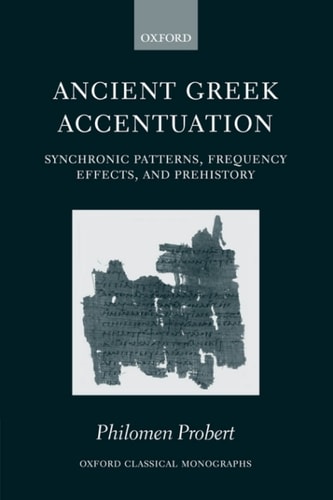
Ancient Greek Accentuation: Synchronic Patterns, Frequency Effects, and Prehistory
0
0
As an Amazon Associate and affiliate partner, Menrva Books earns from qualifying purchases. Learn more
Author Description
The accent of many Greek words has long been considered arbitrary, but Philomen Probert points to some striking correlations between accentuation and a word's synchronic morphological transparency, and between accentuation and word frequency, that give clues to the prehistory of the accent system. Bringing together comparative evidence for the Indo-European accentuation of the relevant categories with recent insights into the effects that loss of transparency and word frequency have on language change, Probert uses the synchronically observable correlations to bridge the gap between the accentuation patterns reconstructable for Indo-European and those directly attested for Greek from the Hellenistic period onwards.
Menrva's Summary
THE THESIS
This work investigates the underlying mechanisms of Ancient Greek accentuation by examining the relationship between synchronic morphological patterns, word frequency, and historical linguistic evolution. Philomen Probert, a scholar in classical philology, utilizes a comparative framework to analyze how accentuation systems shifted from their Indo-European origins to the patterns observed in Hellenistic Greek. By integrating data on morphological transparency with frequency effects, the author provides a systematic explanation for accentual phenomena previously categorized as arbitrary.
THE SCOPE MAP
What You Will Find
- Analysis of Ancient Greek accentuation patterns from the Hellenistic period forward
- Comparative evidence regarding Indo-European accentual categories
- Application of frequency-based linguistic theories to classical morphology
Scope Limits
- The study does not provide a comprehensive dictionary of all Greek word accents
- The analysis focuses primarily on structural and historical patterns rather than pedagogical instruction for language learners
THE AUTHORITY PERSPECTIVE
Experts in the field of classical linguistics recognize this monograph as a rigorous contribution to the study of Greek historical phonology. Readers frequently note the academic density of the prose, which is intended for specialists in Indo-European studies and historical linguistics.
Page Count:
472
Publication Date:
2006-01-01
Publisher:
Oxford University Press
ISBN-10:
0191535494
ISBN-13:
9780191535499
English
Modern Greek
Historical linguistics
Philology
Ancient Greek
English & College Success
Linguistics
Community Tags
Other Editions(2)

Similar Books