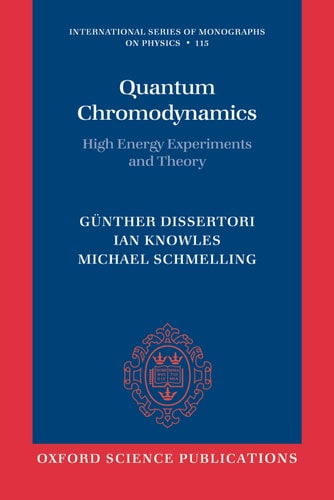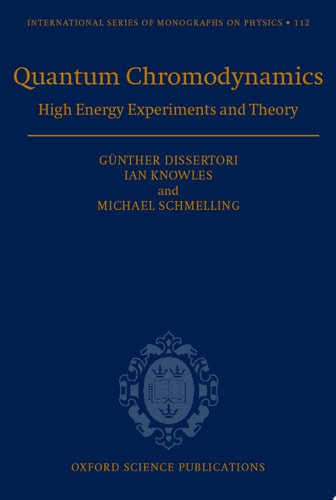
Quantum Chromodynamics: High Energy Experiments and Theory
0
0
As an Amazon Associate and affiliate partner, Menrva Books earns from qualifying purchases. Learn more
Author Description
This book provides an introduction to Quantum Chromodynamics (QCD), the theory of strong interactions. It covers in full detail both the theoretical foundations and the experimental tests of the theory. Although the experimental chapters focus on recent measurements, the subject is placed into historical perspective by also summarizing the steps which lead to the formulation of QCD. Measurements are discussed as they were performed by the LEP experiments at CERN, or at hadron-hadron and lepton-hadron colliders such as the TEVATRON at Fermilab and HERA at DESY. Emphasis is placed on high energy tests of QCD, such as measurements of the strong coupling constant, investigations of the non-abelian structure of the underlying gauge group, determinations of nucleon structure functions, and studies of the non-perturbative hadronization process. This excellent text gives a detailed overview of how QCD developed in the 20th century and where we stand with respect to a quantitative understanding after the turn of the millenium. The text is intended for graduate and postgraduate students as well as researchers, and includes numerous problems and solutions.
Menrva's Summary
THE THESIS
This text investigates the theoretical foundations and experimental validation of Quantum Chromodynamics (QCD) as the primary theory of strong interactions. The authors, Günther Dissertori, Ian G. Knowles, and Michael Schmelling, synthesize historical developments with contemporary high-energy physics data to provide a comprehensive framework for understanding the strong force. The book utilizes a structured approach to bridge the gap between abstract gauge theory and empirical results obtained from major collider experiments.
THE SCOPE MAP
What You Will Find
- Theoretical development of QCD and the non-abelian gauge group structure
- Experimental data from LEP, TEVATRON, and HERA colliders
- Analysis of the strong coupling constant and nucleon structure functions
- Examination of non-perturbative hadronization processes
- Pedagogical problems and solutions for advanced study
Scope Limits
- Does not cover low-energy nuclear physics or non-collider-based QCD applications
- Focuses primarily on high-energy experimental results rather than speculative beyond-standard-model theories
THE AUTHORITY PERSPECTIVE
Experts and academics recognize this volume as a rigorous, foundational resource for graduate-level particle physics. Readers frequently note the technical density of the prose, which is well-suited for researchers requiring a detailed quantitative overview of the field.
Page Count:
562
Publication Date:
2003-01-01
Publisher:
OUP Oxford
ISBN-10:
019100460X
ISBN-13:
9780191004605
Science
Particle Physics
Quantum Chromodynamics
Earth Sciences
Physics
Academic