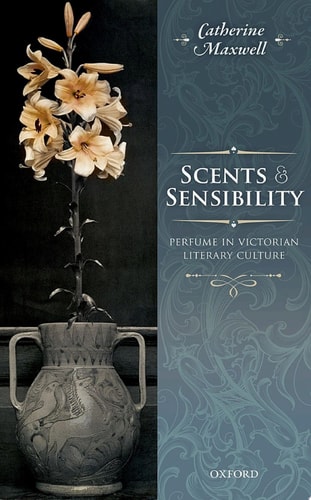
Scents and Sensibility: Perfume in Victorian Literary Culture
0
0
As an Amazon Associate and affiliate partner, Menrva Books earns from qualifying purchases. Learn more
Author Description
This lively, accessible book is the first to explore Victorian literature through scent and perfume, presenting an extensive range of well-known and unfamiliar texts in intriguing and imaginative new ways that make us re-think literature's relation with the senses. Concentrating on aesthetic and decadent authors, Scents and Sensibility introduces a rich selection of poems, essays, and fiction, exploring these texts with reference to both the little-known cultural history of perfume use and the appreciation of natural fragrance in Victorian Britain. It shows how scent and perfume are used to convey not merely moods and atmospheres but the nuances of the aesthete or decadent's carefully cultivated identity, personality, or sensibility. A key theme is the emergence of the olfactif, the cultivated individual with a refined sense of smell, influentially represented by the poet and critic Algernon Charles Swinburne, who is emulated by a host of canonical and less well-known aesthetic and decadent successors such as Walter Pater, Edmund Gosse, John Addington Symonds, Lafcadio Hearn, Michael Field, Oscar Wilde, Arthur Symons, Mark André Raffalovich, Theodore Wratislaw, and A. Mary F. Robinson. This book explores how scent and perfume pervade the work of these authors in many different ways, signifying such diverse things as style, atmosphere, influence, sexuality, sensibility, spirituality, refinement, individuality, the expression of love and poetic creativity, and the aura of personality, dandyism, modernity, and memory. A coda explores the contrasting twentieth-century responses of Virginia Woolf and Compton Mackenzie to the scent of Victorian literature.
Menrva's Summary
THE THESIS
This book investigates how scent and perfume functioned as critical markers of identity, aesthetic sensibility, and cultural expression within Victorian literature. Catherine Maxwell, a scholar specializing in Victorian literature and aesthetics, utilizes a wide array of primary texts—ranging from poetry to essays—to argue that the olfactory sense was central to the construction of the 'olfactif' or the refined, decadent individual. By bridging the gap between cultural history and literary analysis, the author demonstrates how fragrance served as a sophisticated tool for conveying complex themes such as dandyism, sexuality, and modernity.
THE SCOPE MAP
What You Will Find
- Analysis of olfactory imagery in the works of authors such as Oscar Wilde, Walter Pater, and Algernon Charles Swinburne.
- Historical context regarding the cultural practices of perfume use and natural fragrance appreciation in Victorian Britain.
- Examination of how scent signifies personality, memory, and poetic creativity.
Scope Limits
- The study focuses primarily on aesthetic and decadent authors, excluding a broad survey of mainstream Victorian realism.
- The analysis is limited to the late nineteenth-century context, with only a brief coda addressing twentieth-century responses.
THE AUTHORITY PERSPECTIVE
Scholars and critics recognize this work as a pioneering study that successfully integrates sensory history with literary analysis. Readers frequently note the accessible yet scholarly nature of the prose, which provides a fresh perspective on the aesthetic movement.
Page Count:
379
Publication Date:
2017-01-01
Publisher:
OUP Oxford
ISBN-10:
0191005215
ISBN-13:
9780191005213
Aesthetics
Literary Criticism
English
Cultural History
English & College Success
Community Tags
Similar Books