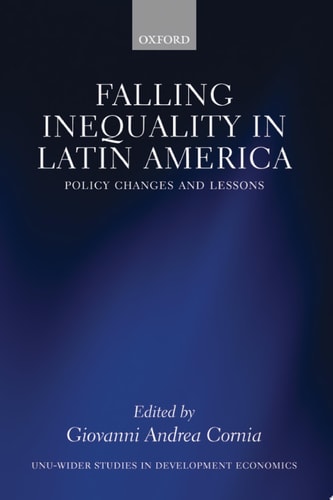
Falling Inequality in Latin America: Policy Changes and Lessons
0
0
As an Amazon Associate and affiliate partner, Menrva Books earns from qualifying purchases. Learn more
Author Description
The volume aims to document and explain the sizeable decline of income inequality that has taken place in Latin America during the 2000s. It does so through an exploration of inequality changes in six representative countries, and ten policy chapters dealing with macroeconomics, foreign trade, taxation, labour market, human capital formation, and social assistance, which point to the emergence of a 'new policy model'. The volume addresses a major issue in economic development with profound implications for many developing regions and those OECD countries mired in a long-lasting financial crisis and economic stagnation. For at least the last quarter of the twentieth century, Latin America suffered from low growth, rising inequality, and frequent financial crises. However, since the turn of the century, growth accelerated, inequality declined, poverty fell, and macroeconomic stability improved, all this in parallel to the spread of centre-left political regimes in three quarters of the region. This inequality decline has taken many by surprise as, for a long time, the region has been a symbol of a deeply entrenched unequal distribution of assets, incomes, and opportunities, limited or no state redistribution, and a deeply embedded authoritarianism enforcing an unjust status quo. The recent Latin American experience is particularly valuable as inequality was reduced under open economy conditions and in a period of intensifying global integration, which have often been considered as a source of rising inequality. In this sense, however imperfect, the recent Latin American experience may be of interest to countries completing their transition to the market and liberal democracy (as in the former socialist countries of Europe), facing a political transition (as those affected by the Arab Spring, Myanmar and countries in sub-Saharan Africa), or recording rises in inequality and social tensions in spite of rapid economic growth (as in China and India). Until recently there
Menrva's Summary
THE THESIS
This volume investigates the factors contributing to the significant decline in income inequality observed across Latin America during the 2000s. Giovanni Andrea Cornia, a prominent economist, compiles research from various contributors to analyze how specific macroeconomic and social policy shifts facilitated this regional trend. The text argues that a 'new policy model' emerged, characterized by changes in labor markets, taxation, and social assistance, which allowed for redistribution even within the context of global economic integration.
THE SCOPE MAP
What You Will Find
- Comparative analysis of six representative Latin American countries.
- Ten thematic chapters covering macroeconomics, foreign trade, and human capital formation.
- Evaluation of the impact of centre-left political regimes on economic distribution.
Scope Limits
- The analysis focuses primarily on the period of the 2000s and does not provide an exhaustive longitudinal study of the entire twentieth century.
- The text does not offer a universal blueprint for all developing nations, but rather highlights specific regional lessons.
THE AUTHORITY PERSPECTIVE
Experts recognize this volume as a comprehensive resource for understanding the intersection of political shifts and economic outcomes in Latin America. Readers frequently note the academic density of the prose, making it a valuable reference for students and professionals in development economics.
Page Count:
400
Publication Date:
2014-01-01
Publisher:
OUP Oxford
ISBN-10:
0191005274
ISBN-13:
9780191005275
Economics
Public Policy
American Studies
Community Tags
Similar Books