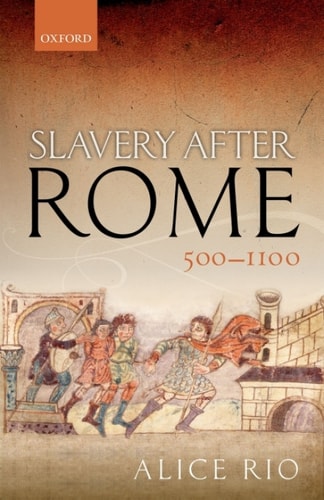
Slavery After Rome, 500-1100
0
0
As an Amazon Associate and affiliate partner, Menrva Books earns from qualifying purchases. Learn more
Author Description
Slavery After Rome, 500-1100 offers a substantially new interpretation of what happened to slavery in Western Europe in the centuries that followed the fall of the Roman Empire. The periods at either end of the early middle ages are associated with iconic forms of unfreedom: Roman slavery at one end; at the other, the serfdom of the twelfth century and beyond, together with, in Southern Europe, a revitalised urban chattel slavery dealing chiefly in non-Christians. How and why this major change took place in the intervening period has been a long-standing puzzle. This study picks up the various threads linking this transformation across the centuries, and situates them within the full context of what slavery and unfreedom were being used for in the early middle ages. This volume adopts a broad comparative perspective, covering different regions of Western Europe over six centuries, to try to answer the following questions: who might become enslaved and why? What did this mean for them, and for their lords? What made people opt for certain ways of exploiting unfree labour over others in different times and places, and is it possible, underneath all this diversity, to identify some coherent trajectories of historical change?
Menrva's Summary
THE THESIS
This work investigates the evolution of slavery and unfreedom in Western Europe between 500 and 1100, challenging traditional narratives regarding the transition from Roman chattel slavery to medieval serfdom. Alice Rio, a specialist in medieval social history, utilizes a comparative framework to analyze how labor exploitation shifted across diverse regional contexts. By examining the legal and social mechanisms of unfreedom, the author argues that the transformation of slavery was not a singular event but a complex, multi-faceted process driven by varying economic and political pressures.
THE SCOPE MAP
What You Will Find
- Comparative analysis of labor systems across Western Europe from the 6th to the 12th century.
- Examination of the legal status of the enslaved and the obligations imposed by their lords.
- Investigation into the transition from Roman-style chattel slavery to medieval serfdom.
- Analysis of regional variations in labor exploitation and social hierarchy.
Scope Limits
- The study focuses primarily on Western Europe and does not provide an exhaustive global history of slavery.
- The analysis is bounded by the 500-1100 timeframe and does not extend into the later developments of the high Middle Ages.
THE AUTHORITY PERSPECTIVE
Historians and scholars of the medieval period recognize this text as a significant contribution to the study of social structures and labor history. Readers frequently note the academic rigor and the author's ability to synthesize complex regional data into a coherent historical argument.
Page Count:
304
Publication Date:
2017-01-01
Publisher:
OUP Oxford
ISBN-10:
0191009024
ISBN-13:
9780191009020
History
European History
Europe
Slavery_europe
Serfdom
Economic History
Social History
Community Tags
Other Editions(3)

Similar Books