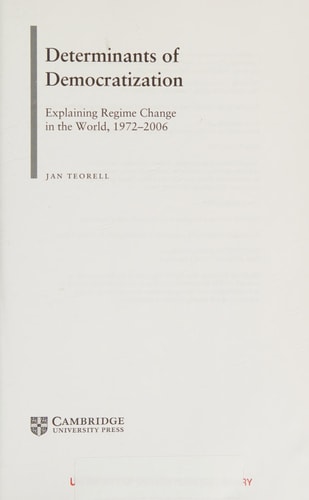
Determinants of Democratization: Explaining Regime Change in the World, 1972-2006
0
0
As an Amazon Associate and affiliate partner, Menrva Books earns from qualifying purchases. Learn more
Author Description
What are the determinants of democratization? Do the factors that move countries toward democracy also help them refrain from backsliding toward autocracy? This book attempts to answer these questions through a combination of a statistical analysis of social, economic, and international determinants of regime change in 165 countries around the world in 1972-2006, and case study work on nine episodes of democratization occurring in Argentina, Bolivia, Hungary, Nepal, Peru, the Philippines, South Africa, Turkey, and Uruguay. The findings suggest that democracy is promoted by long-term structural forces such as economic prosperity, but also by peaceful popular uprisings and the institutional setup of authoritarian regimes. In the short-run, however, elite actors may play a key role, particularly through the importance of intra-regime splits. Jan Teorell argues that these results have important repercussions both for current theories of democratization and for the international community's effort in developing policies for democracy promotion.
Menrva's Summary
THE THESIS
This book investigates the multifaceted determinants of democratization and the conditions that sustain democratic transitions while preventing authoritarian backsliding. It analyzes social, economic, and international factors influencing regime change across 165 countries between 1972 and 2006, supplemented by in-depth case studies of nine democratization episodes. The research posits that while long-term structural elements like economic prosperity are crucial, peaceful popular uprisings and the internal dynamics of authoritarian regimes also play significant roles. Furthermore, the study highlights the critical influence of elite actors and intra-regime divisions in short-term political shifts.
THE SCOPE MAP
- What are the determinants of democratization?
- Do the factors that move countries toward democracy also help them refrain from backsliding toward autocracy?
- Statistical analysis of social, economic, and international determinants of regime change in 165 countries (1972-2006).
- Case study work on nine episodes of democratization (Argentina, Bolivia, Hungary, Nepal, Peru, the Philippines, South Africa, Turkey, and Uruguay).
- Findings on the promotion of democracy by long-term structural forces (e.g., economic prosperity).
- Role of peaceful popular uprisings and institutional setup of authoritarian regimes.
- Importance of elite actors and intra-regime splits in short-run democratization.
- Repercussions for current theories of democratization and democracy promotion policies.
THE AUTHORITY PERSPECTIVE
This book is regarded as a significant contribution to the study of democratization, offering a robust empirical analysis that combines broad statistical data with detailed case studies. The findings, which emphasize both structural factors and the agency of elite actors and popular movements, provide a nuanced understanding of regime change. It is likely to be of interest to scholars of comparative politics, international relations, and policy makers involved in democracy promotion efforts.
Page Count:
222
Publication Date:
2010-10-28
Publisher:
Cambridge University Press
ISBN-10:
0521139686
ISBN-13:
9780521139687
History
Non-Fiction
Politics
Regime Change
Comparative Politics
World history
Community Tags
Other Editions(2)

Similar Books