Animal, Vegetable, Mineral?
0
0
As an Amazon Associate and affiliate partner, Menrva Books earns from qualifying purchases. Learn more
Author Description
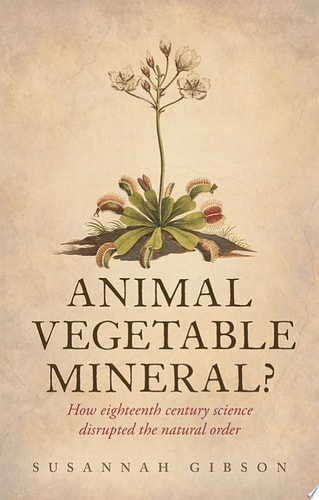
Since The Time Of Aristotle, There Had Been A Clear Divide Between The Three Kingdoms Of Animal, Vegetable, And Mineral. But By The Eighteenth Century, Biological Experiments, And The Wide Range Of New Creatures Coming To Europe From Across The World, Challenged These Neat Divisions. Abraham Trembley Found That Freshwater Polyps Grew Into Complete Individuals When Cut. This Shocking Discovery Raised Deep Questions: Was It A Plant Or An Animal? And This Was Not The Only Conundrum. What Of Coral? Was It A Rock Or A Living Form? Did Plants Have Sexes, Like Animals? The Boundaries Appeared To Blur. And What Did All This Say About The Nature Of Life Itself? Were Animals And Plants Soul-less, Mechanical Forms, As Descartes Suggested? The Debates Raging Across Science Played Into Some Of The Biggest And Most Controversial Issues Of Enlightenment Europe. In This Book, Susannah Gibson Explains How A Study Of Pond Slime Could Cause People To Question The Existence Of The Soul; Observation Of Eggs Could Make A Man Doubt That God Had Created The World; How The Discovery Of The Venus Fly-trap Was Linked To The French Revolution; And How Interpretations Of Fossils Could Change Our Understanding Of The Earth's History. Using Rigorous Historical Research, And A Lively And Readable Style, This Book Vividly Captures The Big Concerns Of Eighteenth-century Science. And The Debates Concerning The Divisions Of Life Did Not End There; They Continue To Have Resonances In Modern Biology.
Menrva's Summary
THE THESIS
This book investigates how eighteenth-century discoveries in natural history dismantled the rigid Aristotelian classification of the natural world into animal, vegetable, and mineral kingdoms. Susannah Gibson, a historian of science, utilizes primary source accounts and historical records to demonstrate how the emergence of anomalous specimens—such as the freshwater polyp and the Venus flytrap—forced Enlightenment thinkers to re-evaluate the fundamental boundaries between living and non-living matter. The work argues that these biological debates were not merely academic, but were deeply intertwined with contemporary philosophical and political shifts regarding the nature of the soul, the role of God in creation, and the mechanical interpretation of life.
THE SCOPE MAP
What You Will Find
- Analysis of eighteenth-century biological classification systems and their failures.
- Historical case studies of specific organisms that defied traditional categorization, including polyps, corals, and carnivorous plants.
- Examination of the intersection between natural history, theology, and political philosophy during the Enlightenment.
Scope Limits
- The text does not provide a comprehensive history of modern taxonomy or post-Darwinian evolutionary biology.
- It focuses primarily on the European intellectual context rather than global scientific developments of the era.
THE AUTHORITY PERSPECTIVE
Experts and readers alike note that the book provides a highly accessible entry point into the complex intellectual climate of the eighteenth century. Scholars appreciate the author's ability to synthesize dense historical debates into a narrative that highlights the profound impact of early biological inquiry on modern scientific thought.
Page Count:
248
Publication Date:
2015-01-01
Publisher:
Oup Oxford
ISBN-10:
0191015237
ISBN-13:
9780191015236
Natural History
Science History
Enlightenment
Biology
Philosophy of
Community Tags
Similar Books