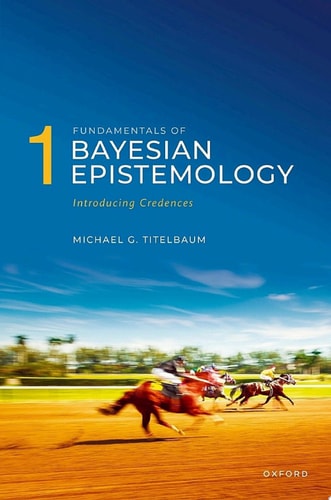
Fundamentals of Bayesian Epistemology 1: Introducing Credences
0
0
As an Amazon Associate and affiliate partner, Menrva Books earns from qualifying purchases. Learn more
Author Description
Bayesian ideas have recently been applied across such diverse fields as philosophy, statistics, economics, psychology, artificial intelligence, and legal theory. Fundamentals of Bayesian Epistemology examines epistemologists' use of Bayesian probability mathematics to represent degrees of belief. Michael G. Titelbaum provides an accessible introduction to the key concepts and principles of the Bayesian formalism, enabling the reader both to follow epistemological debates and to see broader implications Volume 1 begins by motivating the use of degrees of belief in epistemology. It then introduces, explains, and applies the five core Bayesian normative rules: Kolmogorov's three probability axioms, the Ratio Formula for conditional degrees of belief, and Conditionalization for updating attitudes over time. Finally, it discusses further normative rules (such as the Principal Principle, or indifference principles) that have been proposed to supplement or replace the core five. Volume 2 gives arguments for the five core rules introduced in Volume 1, then considers challenges to Bayesian epistemology. It begins by detailing Bayesianism's successful applications to confirmation and decision theory. Then it describes three types of arguments for Bayesian rules, based on representation theorems, Dutch Books, and accuracy measures. Finally, it takes on objections to the Bayesian approach and alternative formalisms, including the statistical approaches of frequentism and likelihoodism.
Menrva's Summary
THE THESIS
This volume investigates the foundational application of Bayesian probability mathematics to represent and evaluate degrees of belief within the field of epistemology. Michael G. Titelbaum, a scholar in the field, utilizes a structured pedagogical approach to explain how formal probability axioms function as normative rules for rational belief. The text serves as a primary introduction to the Bayesian formalism, bridging the gap between abstract mathematical theory and its practical application in philosophical debates.
THE SCOPE MAP
What You Will Find
- Kolmogorov's three probability axioms
- The Ratio Formula for conditional degrees of belief
- The principle of Conditionalization for updating attitudes over time
- Supplemental normative rules including the Principal Principle and indifference principles
Scope Limits
- This volume does not provide the formal arguments for the core rules, which are reserved for the second volume.
- The text does not cover alternative statistical frameworks like frequentism or likelihoodism in depth.
THE AUTHORITY PERSPECTIVE
Experts and students frequently cite this work as a foundational text for those entering the field of formal epistemology. Readers often note the clarity of the prose, which successfully renders complex mathematical concepts accessible to those without an extensive background in statistics.
Page Count:
200
Publication Date:
2022-01-01
Publisher:
OUP Oxford
ISBN-10:
0191017264
ISBN-13:
9780191017261
Philosophy
Logic
Bayesian Statistics
Epistemology
Academic
Probability Theory
Community Tags
Similar Books