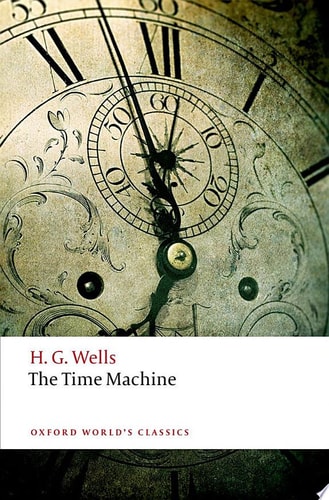
The Time Machine
0
0
As an Amazon Associate and affiliate partner, Menrva Books earns from qualifying purchases. Learn more
Author Description
'so, In The End, Above Ground You Must Have The Haves, Pursuing Pleasure And Comfort And Beauty, And Below Ground The Have-nots, The Workers...' At A Victorian Dinner Party, In Richmond, London, The Time Traveller Returns To Tell His Extraordinary Tale Of Mankind's Future In The Year 802,701 Ad. It Is A Dystopian Vision Of Darwinian Evolution, With Humans Split Into An Above-ground Species Of Eloi, And Their Troglodyte Brothers. The First Book H. G. Wells Published, The Time Machine Is A Scientific Romance That Helped Invent The Genre Of Science Fiction And The Time Travel Story. Even Before Its Serialisation Had Finished In The Spring Of 1895, Wells Had Been Declared 'a Man Of Genius', And The Book Heralded A Fifty Year Career Of A Major Cultural And Political Controversialist. It Is A Sardonic Rejection Of Victorian Ideals Of Progress And Improvement And A Detailed Satirical Commentary On The Decadent Culture Of The 1890s. This Edition Features A Contextual Introduction, Detailed Explanatory Notes, And Two Essays Wells Wrote Just Prior To The Publication Of His First Book.
Menrva's Summary
THE PULSE
A Victorian scientist constructs a machine capable of traversing the fourth dimension, only to discover a terrifying divergence in the future of the human race. The protagonist, known only as the Time Traveller, seeks to witness the ultimate fate of humanity by propelling himself into the year 802,701 AD. Upon arrival, he encounters the Eloi, a fragile and childlike surface-dwelling species, and the Morlocks, a predatory race living in the subterranean depths. The narrative is framed as a first-person account delivered to a group of skeptical dinner guests, establishing a logical, pseudo-scientific foundation for the mechanics of time displacement.
INSIDE THE PAGES
- First-person retrospective narration
- Socio-economic allegory regarding class division
- Darwinian evolutionary theory application
- Scientific romance stylistic framework
- Dystopian world-building
- Satirical commentary on Victorian progress
- Exploration of entropy and the end of the world
- Philosophical inquiry into human nature
THE COLLECTIVE ECHO
Discussion often centers on the stark contrast between the surface-dwelling Eloi and the subterranean Morlocks as a critique of industrial-era class stratification. Readers frequently highlight the effectiveness of the atmosphere, which shifts from intellectual curiosity to visceral dread as the protagonist realizes the true nature of his surroundings. Critics often point to the book's role in establishing the foundational tropes of the time travel subgenre while maintaining a cynical perspective on the inevitability of human decline. The pacing is noted for its rapid transition from Victorian parlor debate to the bleak, expansive vistas of the far future, ensuring the thematic weight remains the primary focus throughout the experience.
Page Count:
144
Publication Date:
2016-01-01
Publisher:
Oxford University Press
ISBN-10:
0191017108
ISBN-13:
9780191017100
Dystopian
Science Fiction
Speculative Fiction
Literature & Fiction
Time Travel
classic
Classics
Community Tags
Other Editions(97)

Seven Books
2025
Default edition
Alpha Edition
2024
Pandora's Box Classics
2023

Independently published
2022

Independently published
2022

Independently Published
2021

Independently Published
2021

East India Publishing Company
2021

Independently Published
2021

Independently Published
2020
Mint Editions
2020

Independently published
2019
Independently Published
2019

Independently published
2019

Classic Comic Store, Limited
2019

Blurb, Incorporated
2019

SDE Classics
2018

CreateSpace Independent Publishing Platform
2018
CreateSpace Independent Publishing Platform
2018

CreateSpace Independent Publishing Platform
2018

CreateSpace Independent Publishing Platform
2018

CreateSpace Independent Publishing Platform
2018

CreateSpace Independent Publishing Platform
2018

CreateSpace Independent Publishing Platform
2018

Independently Published
2018

CreateSpace Independent Publishing Platform
2018

CreateSpace Independent Publishing Platform
2018

CreateSpace Independent Publishing Platform
2018

CreateSpace Independent Publishing Platform
2018
CreateSpace Independent Publishing Platform
2018
CreateSpace Independent Publishing Platform
2018
CreateSpace Independent Publishing Platform
2018

CreateSpace Independent Publishing Platform
2018
CreateSpace Independent Publishing Platform
2018
CreateSpace Independent Publishing Platform
2018

CreateSpace Independent Publishing Platform
2018

CreateSpace Independent Publishing Platform
2018

CreateSpace Independent Publishing Platform
2018

CreateSpace Independent Publishing Platform
2018
CreateSpace Independent Publishing Platform
2018

CreateSpace Independent Publishing Platform
2018

CreateSpace Independent Publishing Platform
2018

CreateSpace Independent Publishing Platform
2018
CreateSpace Independent Publishing Platform
2018

Independently Published
2017
CreateSpace Independent Publishing Platform
2017

CreateSpace Independent Publishing Platform
2017

CreateSpace Independent Publishing Platform
2017

CreateSpace Independent Publishing Platform
2017

CreateSpace Independent Publishing Platform
2017
CreateSpace Independent Publishing Platform
2017

CreateSpace Independent Publishing Platform
2017

CreateSpace Independent Publishing Platform
2017

CreateSpace Independent Publishing Platform
2017

CreateSpace Independent Publishing Platform
2017
CreateSpace Independent Publishing Platform
2017

Independently Published
2017

CreateSpace Independent Publishing Platform
2017
CreateSpace Independent Publishing Platform
2017

Knopf Doubleday Publishing Group
2017

CreateSpace Independent Publishing Platform
2017

Pan Macmillan UK
2017

CreateSpace Independent Publishing Platform
2017
CreateSpace Independent Publishing Platform
2016

CreateSpace Independent Publishing Platform
2016

CreateSpace Independent Publishing Platform
2016
Oxford University Press
2016
OUP Oxford
2016

CreateSpace Independent Publishing Platform
2015
1001 Çiçek Kitaplar
2015

Digireads.com Publishing
2015

Penguin Publishing Group
2014
Capstone Classroom
2014
CreateSpace Independent Publishing Platform
2014

CreateSpace Independent Publishing Platform
2014
CreateSpace Independent Publishing Platform
2013

Simon & Schuster
2013

Dover Publications
2012

CreateSpace Independent Publishing Platform
2011
CreateSpace Independent Publishing Platform
2010
CreateSpace Independent Publishing Platform
2010

Penguin USA, Inc.
2009

Dodo Press
2007

Penguin UK
2007

Stone Arch Books
2007
National Geographic Books
2005
ICON Classics
2005

Digireads.com Publishing
2005
Signet Classic
2002

Orion Publishing Group, Limited
1995
Courier Corporation
1995

RecordedBooks
1992

Random House Children's Books
1990
Random House Audio
1985

Reclam
1984

Caedmon Audio Cassette
1983
Macmillan
1971
Similar Books




Reader Comments
Share Your Thoughts
No comments yet. Be the first to share your thoughts!