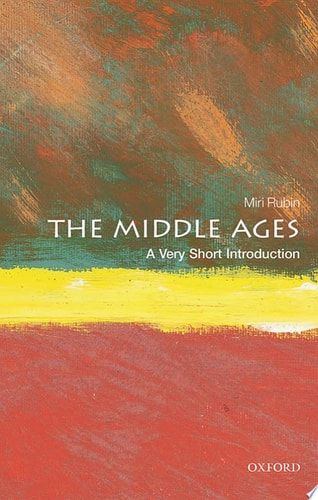
The Middle Ages: A Very Short Introduction
0
0
As an Amazon Associate and affiliate partner, Menrva Books earns from qualifying purchases. Learn more
Author Description
The Middle Ages is a term coined around 1450 to describe a thousand years of European History. In this Very Short Introduction, Miri Rubin provides an exploration of the variety, change, dynamism, and sheer complexity that the period covers. From the provinces of the Roman Empire, which became Barbarian kingdoms after c.450-650, to the northern and eastern regions that became increasingly integrated into Europe, Rubin explores the emergence of a truly global system of communication, conquest, and trade by the end of the era. Presenting an insight into the challenges of life in Europe between 500-1500--at all levels of society--Rubin looks at kingship and family, agriculture and trade, groups and individuals. Conveying the variety of European experiences, while providing a sense of the communication, cooperation, and shared values of the pervasive Christian culture, Rubin looks at the legacies they left behind.About the Series: The Very Short Introductions series from Oxford University Press contains hundreds of titles in almost every subject area. These pocket-sized books are the perfect way to get ahead in a new subject quickly. Our expert authors combine facts, analysis, perspective, new ideas, and enthusiasm to make interesting and challenging topics highly readable.
Menrva's Summary
THE THESIS
This book investigates the complex evolution of European society, culture, and political structures across the millennium spanning from 500 to 1500. Miri Rubin, a professor of Medieval and Early Modern History, utilizes a thematic approach to synthesize a vast historical period. She argues that the Middle Ages was not a static era of darkness, but a dynamic epoch characterized by significant change, global integration, and the development of shared cultural values.
THE SCOPE MAP
What You Will Find
- Analysis of the transition from the Roman Empire to Barbarian kingdoms.
- Examination of social hierarchies, including kingship, family structures, and agricultural life.
- Overview of the expansion of trade, communication, and Christian cultural influence.
- Discussion of the integration of northern and eastern regions into the European sphere.
Scope Limits
- The text does not provide an exhaustive chronological narrative of every political event.
- It focuses primarily on European experiences rather than a comprehensive global history of the era.
THE AUTHORITY PERSPECTIVE
Readers frequently note the accessibility and conciseness of the prose, which makes complex historical trends understandable for non-specialists. Experts highlight this as a foundational text for beginners seeking a thematic overview of medieval European development.
Page Count:
144
Publication Date:
2014-01-01
Publisher:
OUP Oxford
ISBN-10:
0191019542
ISBN-13:
9780191019548
History
Non-Fiction
European History
Middle Ages
Community Tags
Similar Books