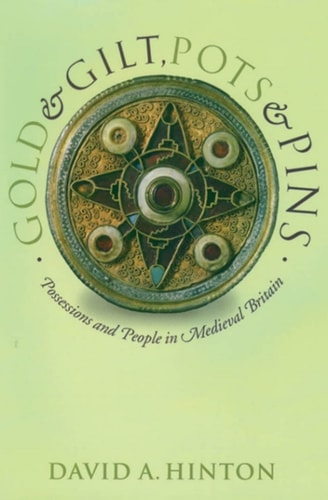
Gold and Gilt, Pots and Pins: Possessions and People in Medieval Britain
0
0
As an Amazon Associate and affiliate partner, Menrva Books earns from qualifying purchases. Learn more
Author Description
In medieval Britain people wore jewellery made of gold if they were rich, of base metal if they were poor; they might hoard their property, or give it away to guarantee that they would have friends when needed; and many of them paid tax on their possessions. In Gold and Gilt, Pots and Pins, David Hinton reviews the significance of artefacts in this period. From elaborate gold jewellery to clay pots, he looks at what possessions meant to people at every level of society. His emphasis is on their reasons for acquiring, keeping, displaying, and disposing of the things that they wore and had in their houses. Drawing on a wide range of physical and documentary evidence, including objects from archaeological excavations and written sources, he argues that the significance of material culture has not been properly taken into account in explanations of social change, particularly in the later Middle Ages. He also explores how identity was created, and how social division was expressed and reinforced. An overall review that looks at evidence in Scotland and Wales as well as in England, this book ranges chronologically from the end of the Roman rule of Britain to the introduction of the new modes and practices that are usually termed 'Renaissance', marked by the changes in religion. Profusely illustrated, the author provides a fascinating and illuminating window into the society of the Middle Ages.
Menrva's Summary
THE THESIS
This work investigates how the possession and display of material objects functioned as a primary indicator of social identity, status, and economic behavior in medieval Britain. David A. Hinton, a specialist in medieval archaeology, synthesizes physical evidence from excavations with contemporary documentary sources to challenge existing historical narratives. He argues that material culture has been historically undervalued as a driver of social change and that the acquisition or disposal of goods served as a critical mechanism for reinforcing social hierarchies and personal identity.
THE SCOPE MAP
What You Will Find
- Analysis of material culture ranging from gold jewelry to domestic clay pottery.
- Examination of social behaviors including hoarding, gift-giving, and taxation practices.
- Comparative study of evidence across England, Scotland, and Wales.
- Chronological coverage from the post-Roman period through the onset of the Renaissance.
Scope Limits
- The text focuses primarily on the social and symbolic function of objects rather than providing a comprehensive technical manual for archaeological excavation methods.
THE AUTHORITY PERSPECTIVE
Scholars and historians frequently cite this work as a valuable interdisciplinary bridge between archaeological findings and social history. Readers often note the accessible yet rigorous nature of the prose, which makes complex material culture analysis available to both students and established researchers.
Page Count:
452
Publication Date:
2005-01-01
Publisher:
Oxford University Press
ISBN-10:
0191532622
ISBN-13:
9780191532627
History
British History
Middle Ages
Great Britain
Archaeology
Social History
European History
Community Tags
Similar Books